Instrumental Works
Intermezzo
After Lucky, before Peter and the Wolf
Not too many years ago, I had a notion to turn one of the most unique, recognizable, downright famous, and totally beloved works in all of classical music into a stage musical. At first, I did not know whether I could achieve such a thing, plus, as far as I knew, the work was protected by copyright. I went to speak with the President of the firm that represented the piece in the West (an old friend and fellow baseball fan of mine from an ASCAP committee of which we were both members.) I blew plentiful amounts of smoke about the potential project, and fooled nobody. The President told me to go home and actually write five or so minutes of what I had in mind (which, in that moment, was next to nothing.) And home I went with my assignment and, much to my surprise, I found a way. Inspired by the greatness of its composer, I wove in my own transformations and creations and thus Peter and the Wolf, a Stage Musical began to be born. I brought in what I had done within a few weeks to the President, and got an enthusiastic go ahead. And Sergei Prokofiev proved to be the ideal collaborator: dead, and a cosmic genius. Based on Prokofiev’s story and score, I wrote the book and lyrics for it, put the dramaturgy and lyrics in the mouths of the cast of unforgettable characters, dropped the narration, and added a chorus. Since I am not the type to paint a mustache on the Mona Lisa, I did not change, or interpolate alien music, into Prokofiev’s music, at all. I was finished in a matter of months, but there was a problem.
I stretched the length of the new show as much as was viable, but it was still too short to be long enough as a full evening in the theater. It might have constituted one half of a double bill, but with what? My solution was to write a prequel to PATW, set in the same meadow and farmstead as PATW, and with a cast almost identical to the original PATW. Thus Lucky was born, a story based on an Aesop Fable, about what was happening at a time in the meadow and farmstead before the story of Peter and the Wolf begins. I would have gladly deferred to Prokofiev as composer, had he been available. In his unfortunate absence, I wrote the book, music, and lyrics for Lucky.
The present Intermezzo occurs during, or at the close of the intermission between Lucky and Peter and the Wolf, a Stage Musical. It is scored for English Horn, Horn, Harp, and Strings. A composite rehearsal piano is also provided. It is offered only as a set - full score, plus all individual parts.
Elsewhere on this site, we offer full piano-vocal scores to both Lucky and Peter and the Wolf, a Stage Musical.


J. S. Bach: Fifteen Two-Part Inventions
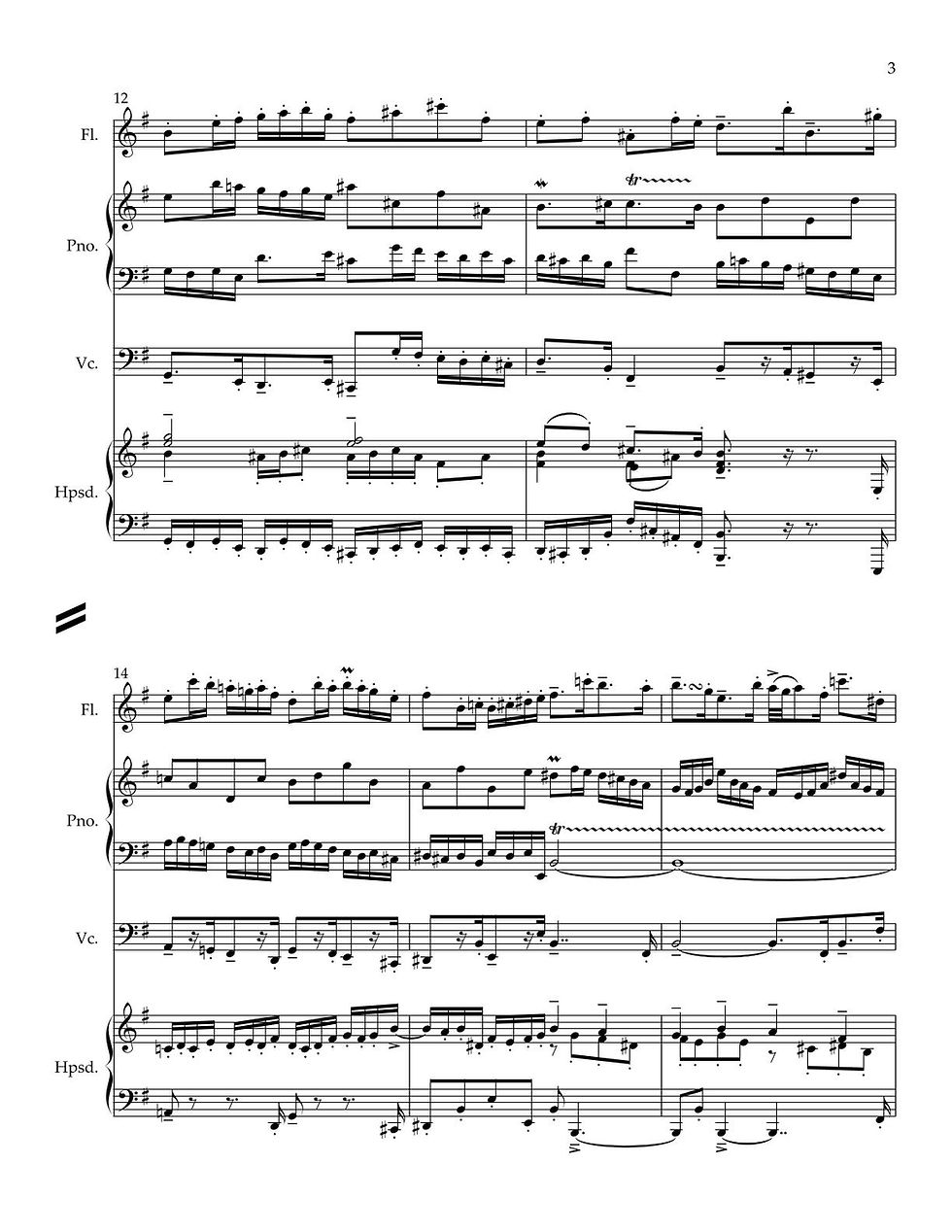
arranged for Solo Keyboard, Flute (or Oboe, Violin, or Clarinet,) Violoncello/Continuo, and Harpsichord
If both books of J.S. Bach’s The Well-Tempered Clavier constitute the “bible” of piano study, performance, and musical composition, then The Fifteen Two-Part Inventions must be the “catechism” of music, brilliant preparatory material for the big leagues. For in these seemingly simple compositions is a highly sophisticated, complex, and quite complete world of musical composition and piano playing (as stated by Bach himself,) covering (or suggestive of) highly evolved counterpoint, harmony, part writing, and many other essential aspects of musical composition. It is no wonder that these pieces have survived so long as benchmarks in the fundamentals of piano playing and composition.
At the invitation of Mme. Mila Filatova, the great pianist, teacher, pedagogue, and director of New England’s Sempre Musick group, I transformed each of the Inventions into a brief piece of chamber music, sort of a Baroque trio sonata. To the original, untouched Invention, I wove an original solo instrumental part, basso continuo (Violoncello or Bassoon,) and a completely developed part for harpsichord around the Invention. Thus, the solo pianist has the opportunity of not only performing his or her chosen Invention, but creating a new piece of music as he or she learns, practices, rehearses, and performs the Invention with the small ensemble. A note about the solo instrument part in each of the Inventions: although here published as a flute part, the part can readily be played on violin, oboe, possibly clarinet, with no (or very few) essential alterations. I might have created separate parts for all these instruments, but I am far too lazy for that! Each Invention includes a full score, plus parts for flute, continuo, and harpsichord. In addition to each individual Invention being offered, all 15 are offered together at a significant discount.
Price, each Invention: $13.95
Price, all 15 Inventions: $150
Invention No. 1 In C Major, BWV 772
Invention No. 2 In C Minor, BWV 773
Invention No. 3 In D Major, BWV 774
Invention No. 4 In D Minor, BWV 775
Invention No. 5 In E-Flat Major, BWV 776
Invention No. 6 In E Major, BWV 777
Invention No. 7 In E Minor, BWV 778
Invention No. 8 In F Major, BWV 779
Invention No. 9 In F Minor, BWV 780
Invention No. 10 In G Major, BWV 781
Invention No. 11 In G Minor, BWV 782
Invention No. 12 In A Major, BWV 783
Invention No. 13 In A Minor, BWV 784
Invention No. 14 In B-Flat Major, BWV 785
Invention No. 15 In B Minor, BWV 786
All 15 Two-Part Inventions, Complete


Johann Sebastian Bach
Italian Concerto, BWV 971
arranged for Keyboard, Strings, and Harpsichord by Lawrence Rosen
Composed in around 1735, J.S. Bach’s Italian Concerto has long stood as a monument of the solo keyboard repertoire, unique even among other keyboard masterworks of Bach. But if the composition is for solo keyboard, why is it called a concerto - usually a piece for solo instrument with orchestra? Well, you are invited to research the easily obtainable explanation on your own. But again, as with our edition of the Two-Part Inventions (please see elsewhere,) Mme. Mila Filatova of the Sempre Musick group in New England inquired if the Italian Concerto could somehow be transformed into a “real” concerto. And so we have the present offering: all three movements of the Italian Concerto scored for the original, completely unaltered solo keyboard part with a full string orchestra (Violins I and II, Viola, Violoncello, and Contrabass,) and with added continuo in the form of an original, fully concerted part for Harpsichord. The first movement was premiered in the Spring of 2024 in New England with Mme. Filatova and her group, Sempre Musick.
You can obtain our new version either by purchasing each of the three movements separately, or choosing the complete Italian Concerto - all three movements together. All movements come with a master orchestral score, and a set of parts (Violins I and II, Viola, Violoncello, Contrabass, and Harpsichord.)
A thought about the Harpsichord: few orchestras and ensembles have access to a "real" Baroque or early Classical period Harpsichord. They can be very expensive, are usually on the fragile and finicky side, and are difficult to keep in tune and in working order. Fortunately, modern synthesizers and samplers almost always have quite excellent digital renderings of the instrument, often with a choice of registration and tone quality. I have personally heard quite a few excellent concerts which have used a digital instrument in place of the real thing, and have personally performed on one for recitatives in a Handel opera.
Price, each movement: $30
Price, all three movements: $75


Sonata In A
for Violin and Piano
When I am not engaged in writing the music and lyrics for a new stage musical, or in collaboration, development, and production of same, it is more than likely that I will be writing an instrumental or vocal work that I have been thinking about, frequently for quite some time. Standard or mixed chamber-sized ensembles are usually the medium, rather than orchestral or experimental instrument, vocal, and/or electronic combinations.
I had always loved the familiar medium (and its literature) of violin and piano, and as far back as high school and early conservatory, had done a few pieces and sets for the duo. I also had written an extended Chacony, for solo violin, parts of which my teacher, the celebrated Italian composer Luciano Berio, incorporated into his Sequenza VIII, for Solo Violin, for which I was very flattered and honored. And yet, I had never done anything “big” for the violin/piano combination, and certainly had never attempted, or even imagined, a Violin Concerto.
My Sonata in A for Violin and Piano, is my “big one” for this instrumentation. It is most definitely big, if nothing more, in scope and size, comprising five movements and a hefty length. It was also carefully designed that several of the movements may be satisfactorily performed as stand alone pieces. It is a virtuoso piece, both for the violinist and pianist, and is available here as a complete score, plus violin part. I fully expect that a piece like this will continue to be infrequently performed, so if you decide to present the Sonata (or even a movement or two of it,) please let us know.


Price, Score and Part: $49.95
The Gatsby Dances
for Violin and Piano
In the middle of Act II of our show, Gatsby, An American Musical, (please see listing under the “Theatrical Works” category,) a huge party with hundreds of guests is underway at the Gatsby mansion in fictional West Egg, located on Long Island’s North Shore. The probable, actual location would be in the town of Sands Point. An extended dance sequence at the party breaks out, with a number of dances, danced by different characters and groups, sequentially presented. The lovers’ dance, The Gatsby Waltz, is included, though danced briefly by the ensemble and not by Gatsby and Daisy, as at the conclusion of Act I. The tragic Myrtle crashes the party and dances a solo, drunken Tango Sensual until she is collared and unceremoniously escorted out.
My friend, the great Korean-American violinist, Khullip Jeung, asked me to make versions of two of the dances for violin and piano, and subsequently, we recorded them at Ted Spencer’s studio on the Upper West Side of Manhattan. Both dances - The Gatsby Waltz and Tango Sensual - are offered here, with both full score and violin part for each.


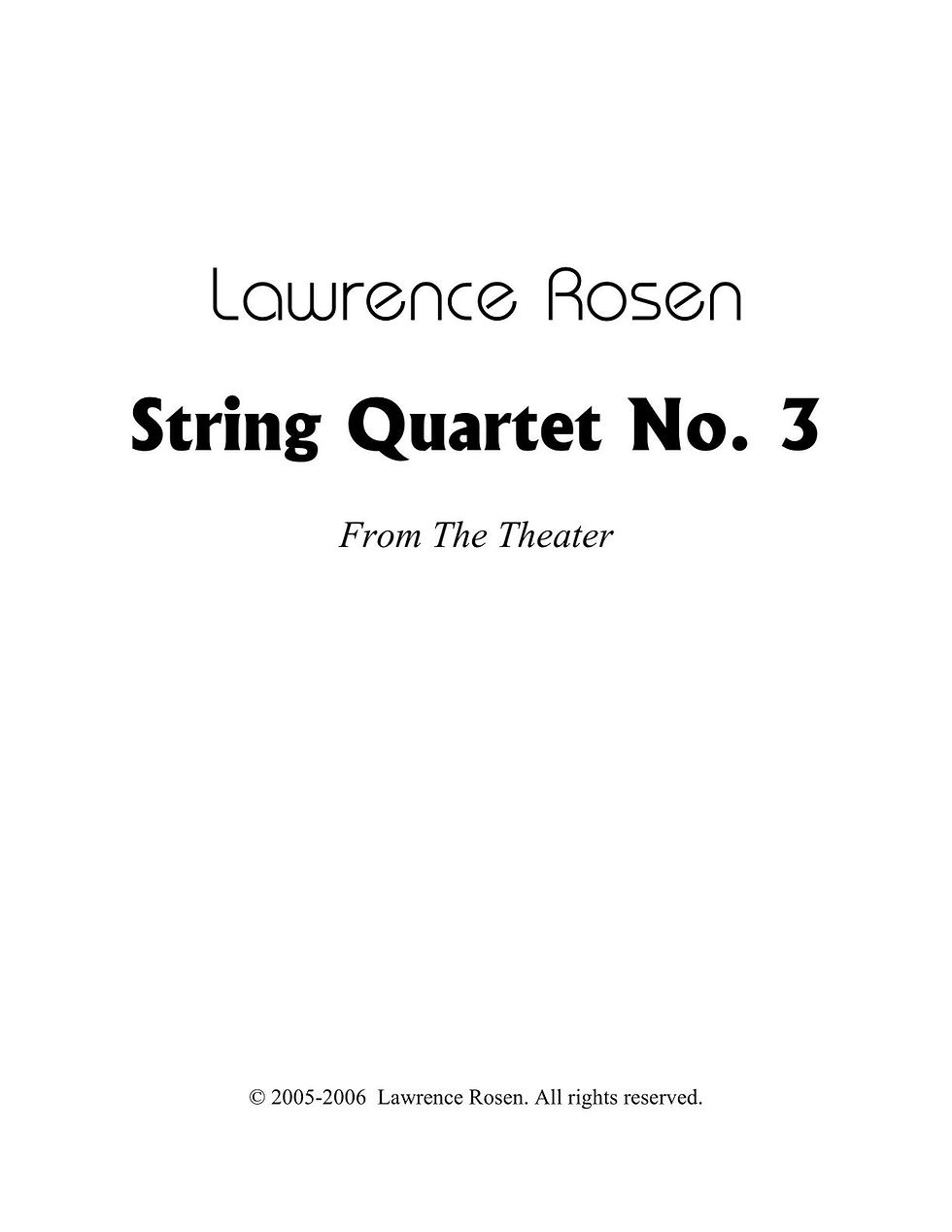
String Quartet No. 3
From The Theater
As I have alluded to elsewhere on this site, when not engaged in the writing and production of works for the (commercial) musical stage, it is likely I’ll leap at the opportunity to charge headlong into the writing of an instrumental or vocal composition or even, as occasionally happens, accept a commission to write a piece for an individual or organization. Invariably, I truly relish these chances, and set to the task with great gusto.
Curiously, perhaps because it can be some time between periods of non-theatrical composition, the pieces tend to be just a bit long - some detractors would undoubtedly say . . . inordinately so. At a level below the threshold of consciousness, it could be that I’d have been thinking about the sweet time when present theatrical activities were going into a welcome recess, and like the everyday metaphor of the tea kettle boiling over, there’s a big head of steam waiting to be released - especially when there is no outside individual or entity to impose guidelines and restrictions.
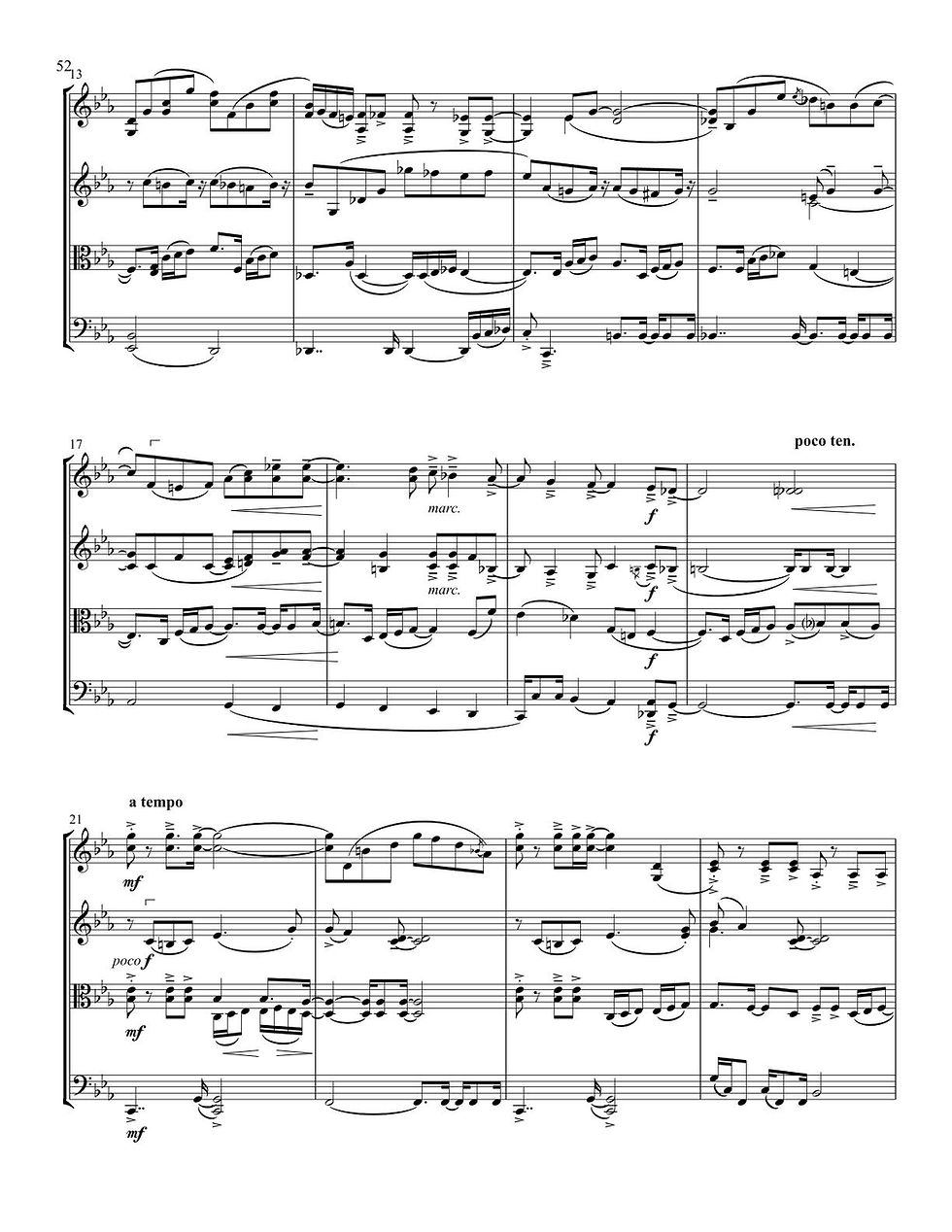
All of which brings us to the present composition, String Quartet No. 3, subtitled From The Theater. To an even greater extent than other non-theatrical works, this quartet draws heavily, and often exclusively, on theatrical works (produced and not yet produced) for the bulk of its thematic material, through all five movements. Since the entire quartet is on the lengthy side, it may be satisfactorily possible to perform excerpted movements or, to think about abridgement in reverse, to drop whole movements entirely. I am personally unsure about this approach, and would leave these decisions up to the performing quartet. Offered for sale is a complete Score, an informative Table of Contents, as well as a complete set of parts for the entire String Quartet No. 3. Performance side note: simply because of the nature of much of the music, the page turns are impossibly quick - or just plain impossible. I’m afraid I will have to leave best solutions up to individual performers.
I have mentioned him elsewhere on this site, and probably will again . . . the String Quartet No. 3 is dedicated to one of the great classical composers of the second half of the twentieth century, one of my teachers, and later, one who I am proud, and incredibly honored, to have eventually called my friend and colleague: Luciano Berio. Generally perceived as a radical, avant-garde modernist, he was a musician of extraordinarily wide interests and capabilities, which might surprise many. Always missed and of blessed memory, he thought more of me than I ever thought of myself, and for that I owe him a debt of gratitude which I could never repay.