Theatrical Works
Gatsby, An American Musical
Book/Libretto By Daniel Landon
Music and Lyrics by Lawrence Rosen
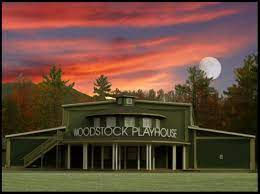
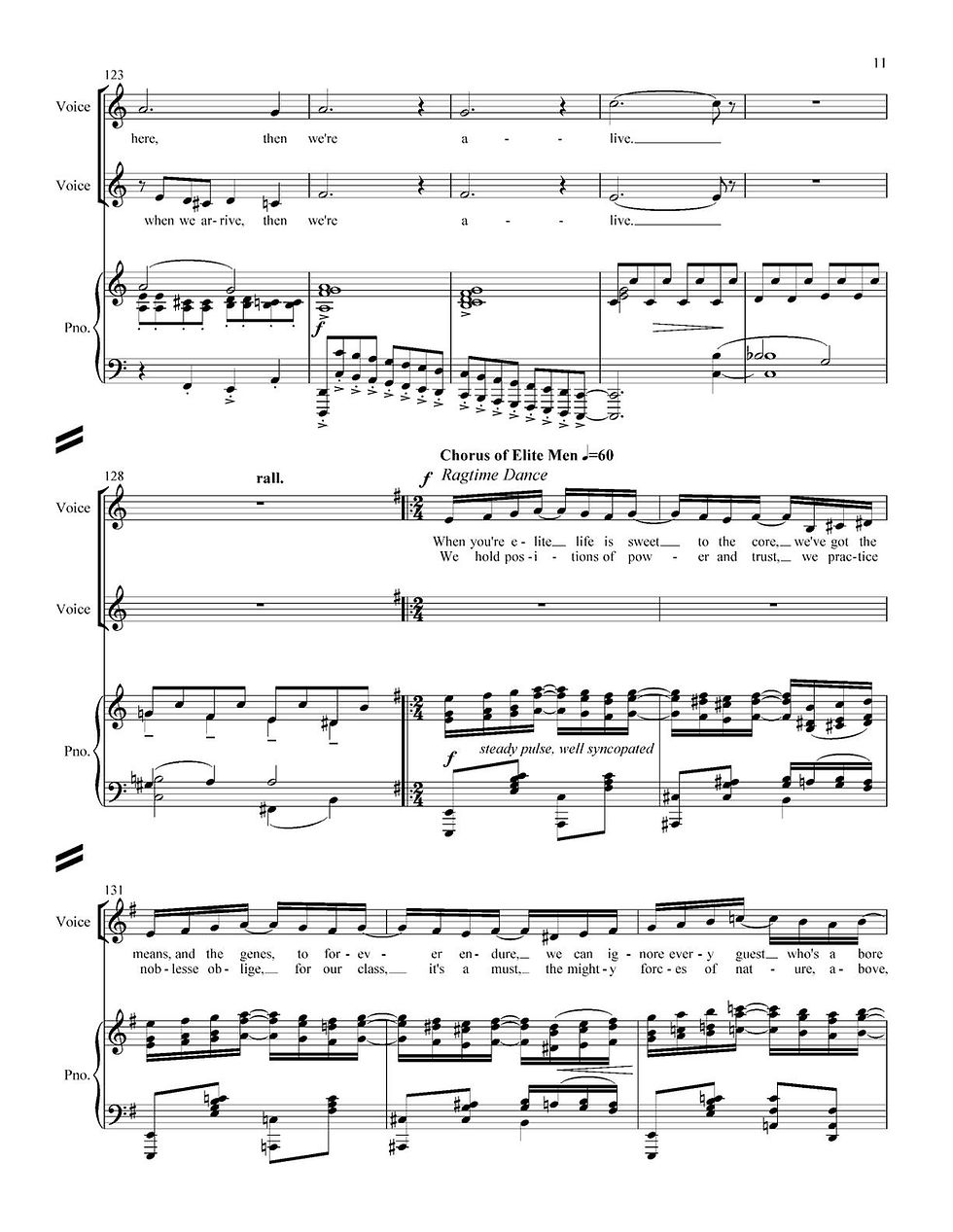
Gatsby, An American Musical was produced by and premiered at the legendary Woodstock Playhouse in Woodstock, New York, during the summer of 2022 with a cast of 25. It features book and adaptation by Daniel Landon, Music and Lyrics by Lawrence Rosen, and was directed and choreographed by Randy Conti, with musical direction by Robert J. Tomasulo. Prior to the premiere, a demo recording of some of the songs was made by some of Broadway’s most notable performers.
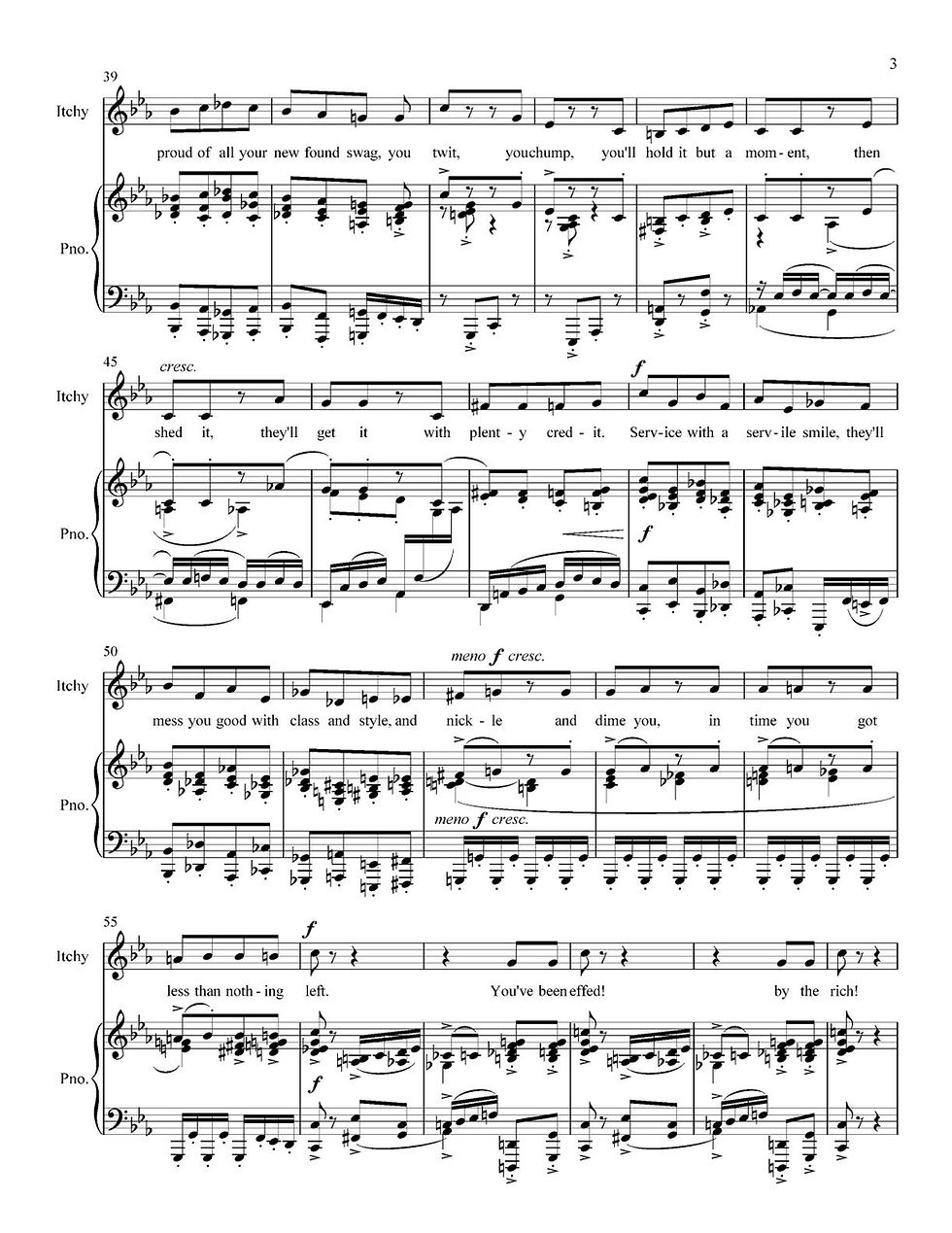
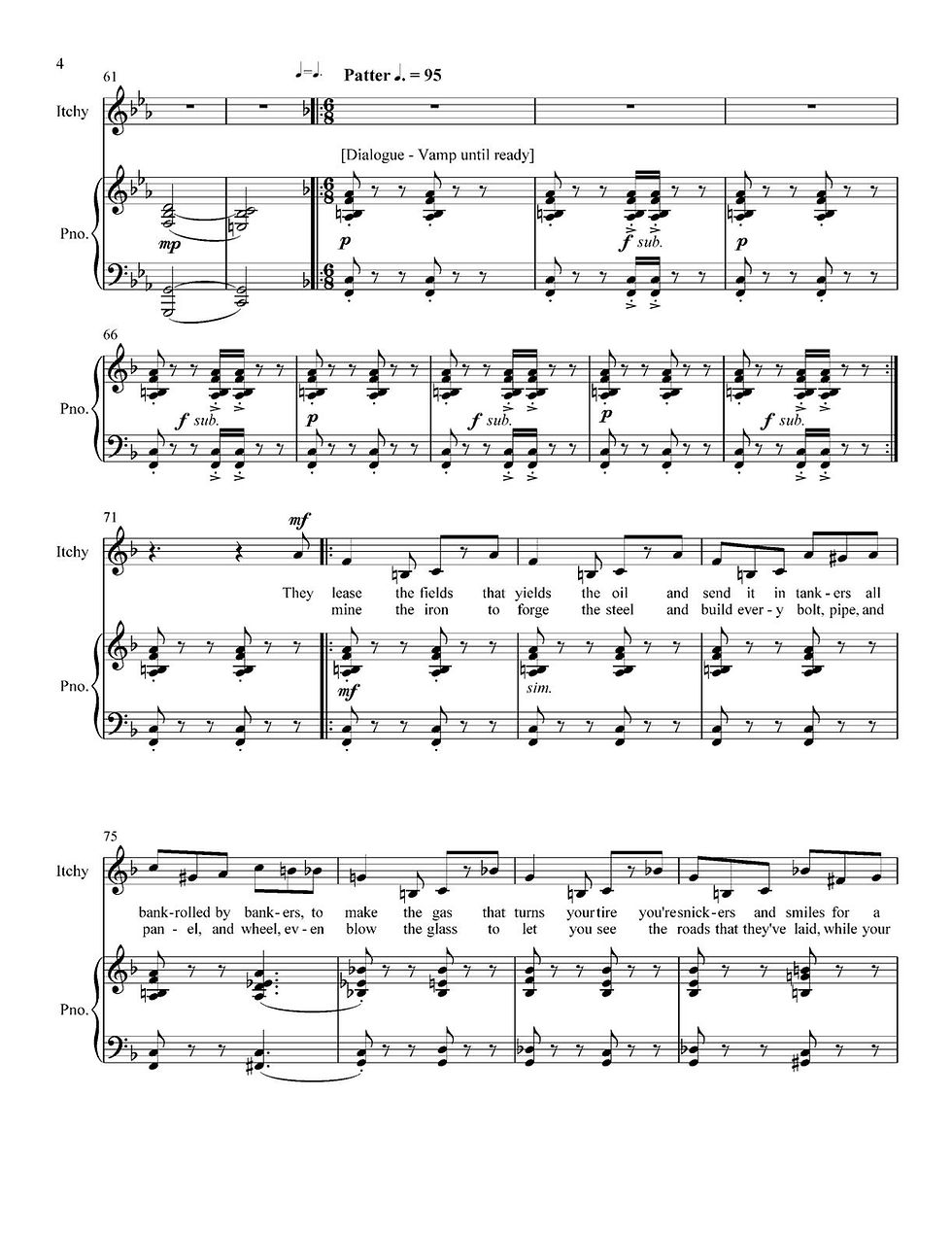
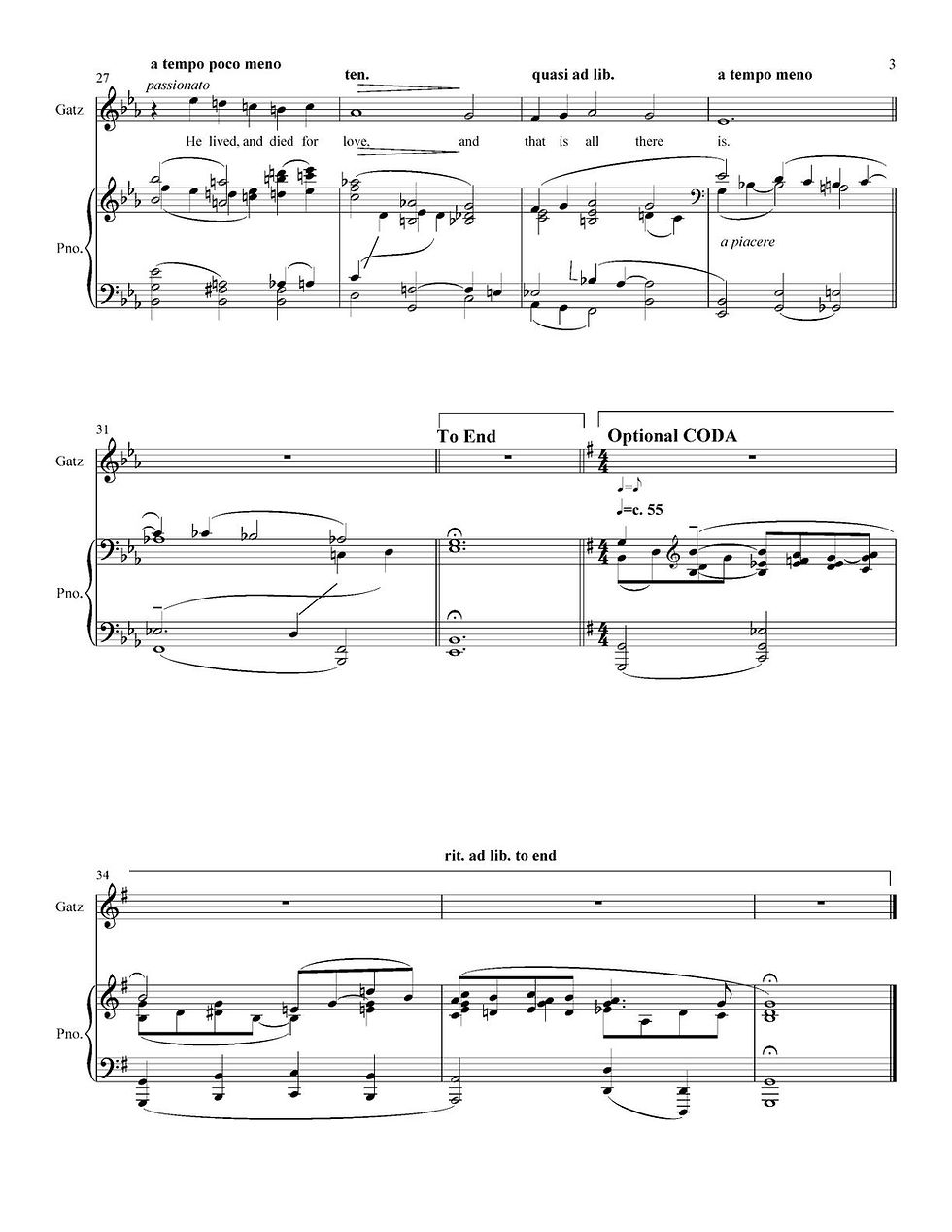
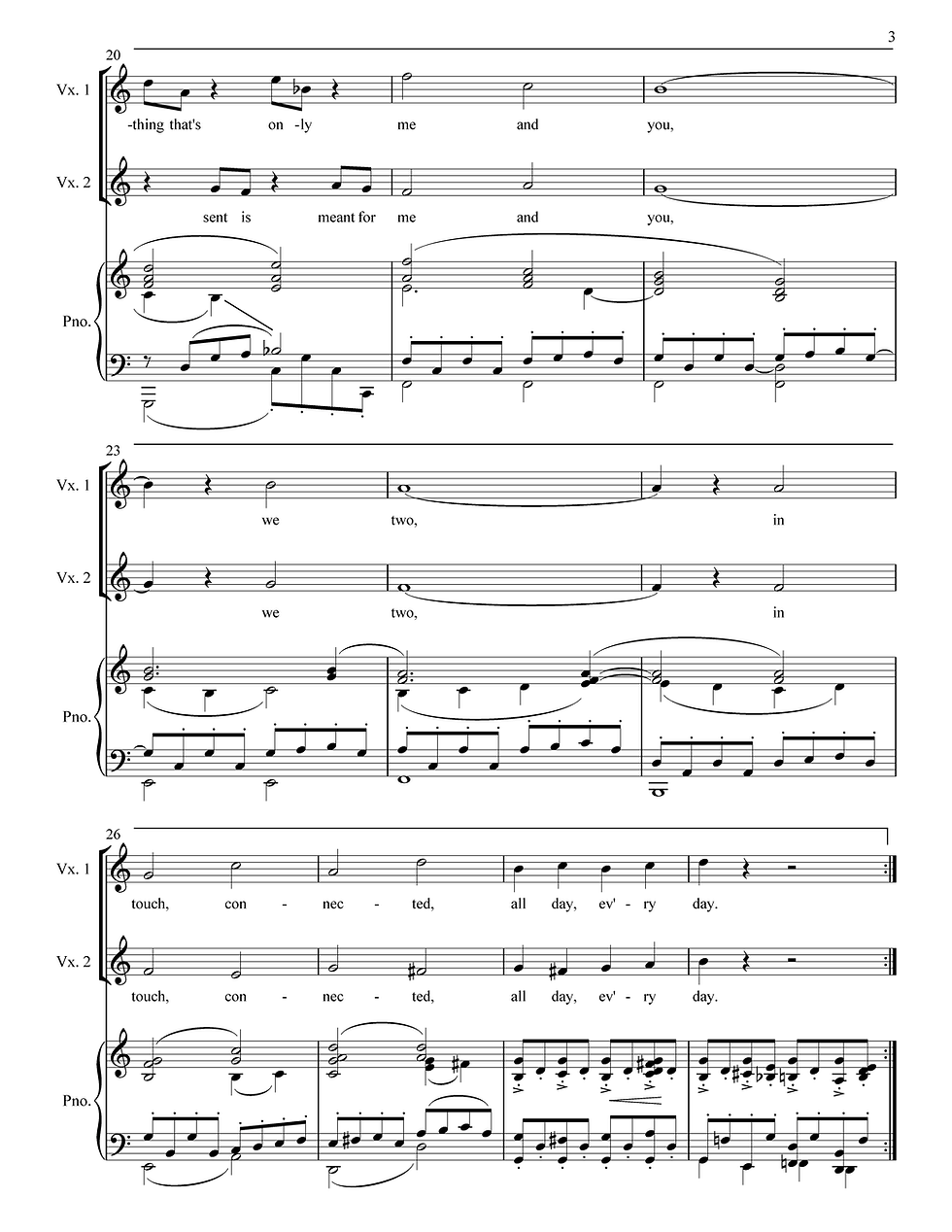
The piano-vocal score is offered here for both perusal and download/purchase. As with most musical stage shows, the score might be in a state of constant development and change, but the scores presented here are current as of 2026. Since this is a theatrical score, some of the lyrics may not be immediately apparent in their meaning when performed apart from the show . . . though knowing the incomparable novel by F. Scott Fitzgerald can go a long way in making things clear. At the beginning of Act I, there is a complete listing of all the musical numbers in the entire show. And note: appended to the score is a number entitled For The Love Of Life, the introduction of Jay Gatsby in the show, and a number in which he reveals to us a great deal about himself and his past. It usually replaces his original number, Her Light, at the same spot in Act I. The replacement number is much more concise, dramatically revealing, and to the point about Gatsby, his background, and his current state of mind. We all like Her Light very much, but at the same time feel that For The Love Of Life is an altogether superior theatrical number.
Downloading, studying, learning, and performing these songs does not come with permission to present the full musical play - for which you would, in any case, need Mr. Landon’s libretto. For information about full theatrical presentation, we invite all inquiries.
$89.95








Thanksgiving At Molly's
Dramatorio
A Fantastical Family Musical
For many years I was privileged to serve as a standing member of the Special Classification Committee at ASCAP. Meeting about every six weeks and made up of a very accomplished group of musical figures from diverse musical backgrounds, it was a very lively, vigorous, occasionally witty, and collegially argumentative group . . . almost like an ASCAP version of the old Algonquin Round Table, although we had very specific tasks to accomplish for ASCAP during the course of our meeting.
At one meeting, an interesting discussion came up about music of, for, or about our many and various national holidays. It was unanimously decided that, by far, Thanksgiving got the shortest end of the stick. The Committee “declaration” was that something should be done about this. A gauntlet was thrown down, a (very abstract) challenge to any and all (at our meeting, or anywhere else) to significantly pick up the slack. A few sets of eyes began to drift toward me, and I, as if surrounded by a group of schoolyard bullies and wishing to be seen as a faithful member of the gang, rather foolishly fell for the provocation. Within a short amount of time, Thanksgiving at Molly’s, a Dramatorio, was the result.
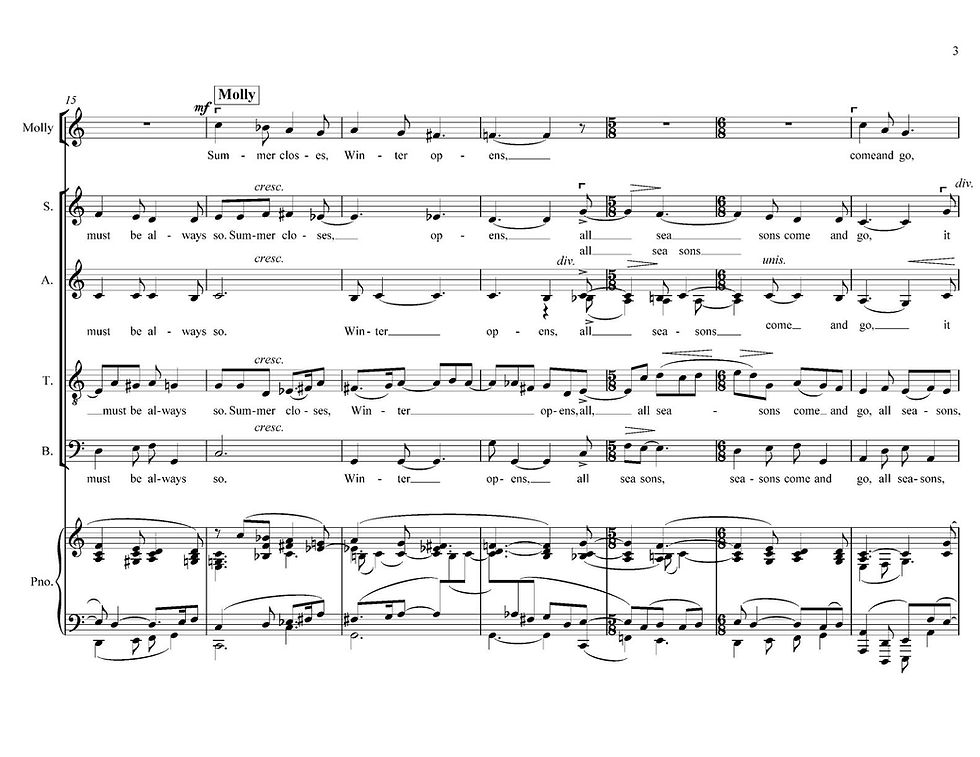
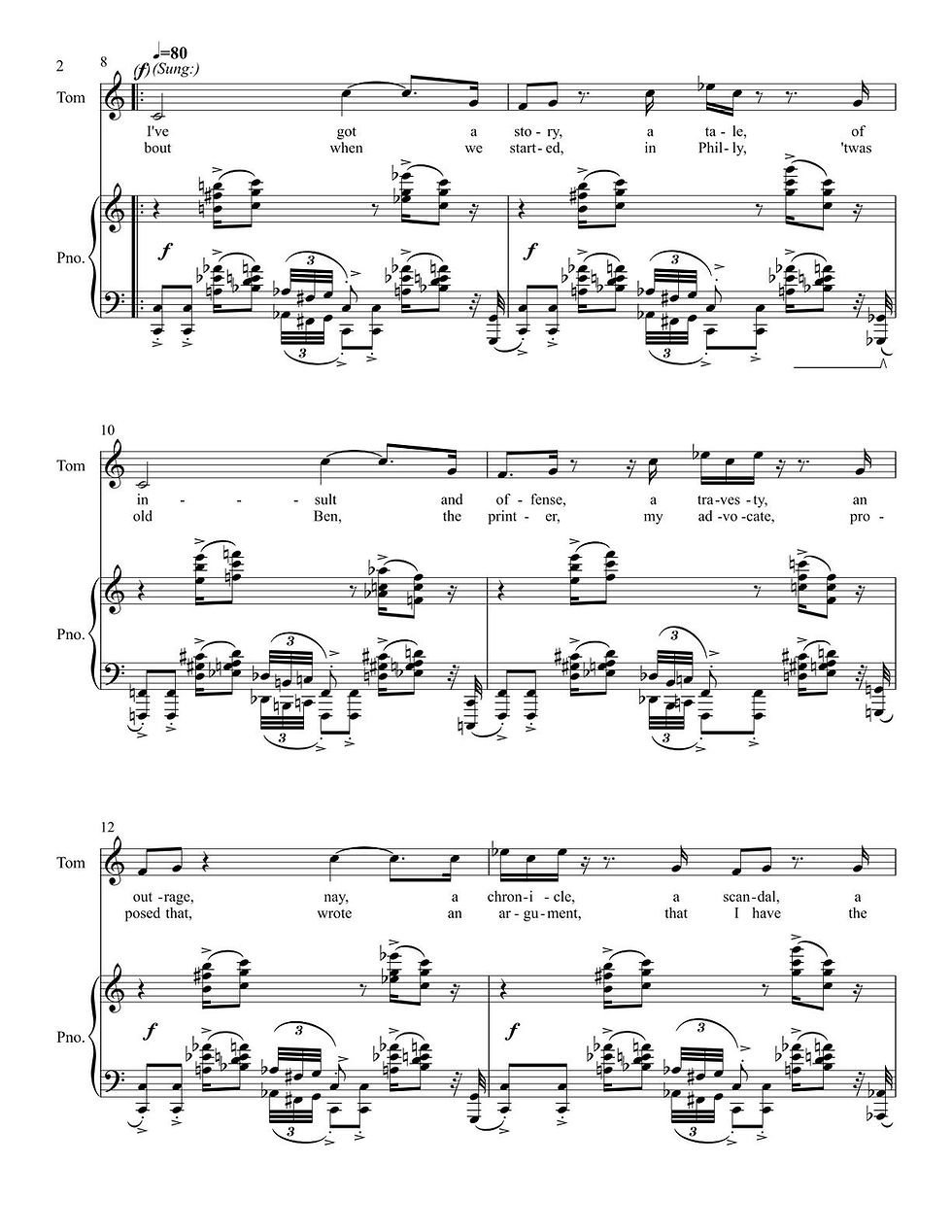
Subtitled “A Fantastical Family Musical” Thanksgiving at Molly’s is a Dramatorio, a work in which the scenario, book, music, and lyrics are created in such a way that a performance “in chairs” can, alternatively and readily, be converted to a fully staged version of the work. Offered here, is a piano-vocal score of the songs, with a Dramatis Personae, an Index of Musical Numbers, and some Production Notes included. As with all other works written for the stage, the Scenario/Libretto/Book is available separately under a performance contract - please inquire if interested. The songs from the show included here may be studied and performed as desired.
The show is essentially about a local Thanksgiving dinner among family, neighbors, and friends. With one exception (hence the subtitle “Fantastical”:) Professor Tom Franklin is a turkey, and only Molly, the teenage girl of the household can see and communicate with him. The Professor ultimately teaches us far more than we have likely ever known about Thanksgiving, its origins and history, as well as how and why the eagle, rather than the turkey eventually became the national bird (as noted by no less than Benjamin Franklin himself.) Intrigued?










Central Park Bench
A Musical Fable In Eleven Scenes
For Two Characters
I am an occasional reader of the venerable entertainment trade publication Variety, and like countless others, have always loved their use of “slanguage,” especially in their headlines . . . Sticks Nix Hick Pix . . . is undoubtedly the most legendary (i.e., rural folks don’t like films about rural folks and topics.) They have also been credited with inventing such words and phrases as striptease, payola, and boffo, as well as the term show biz itself. And the designation two-hander . . . a vehicle for two performers.
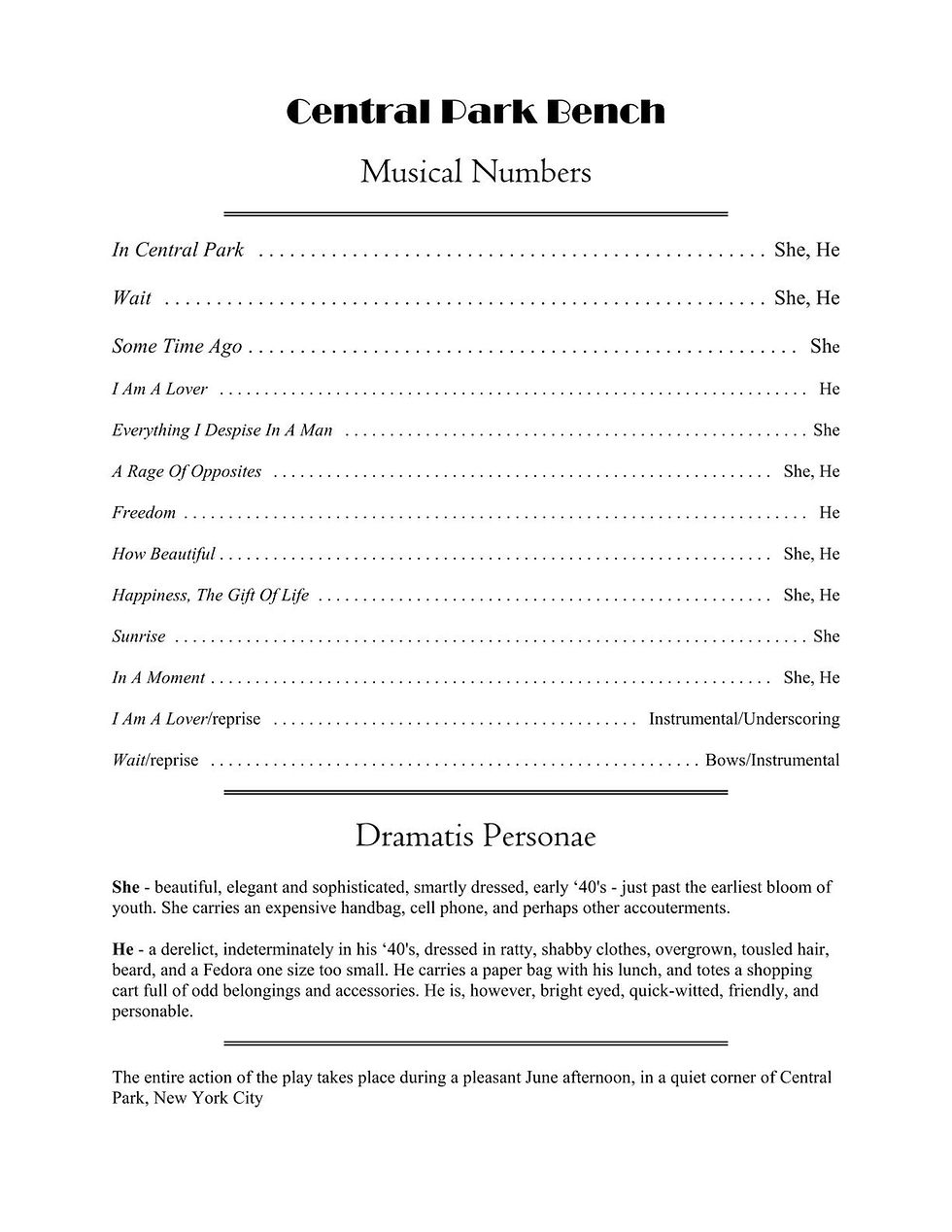
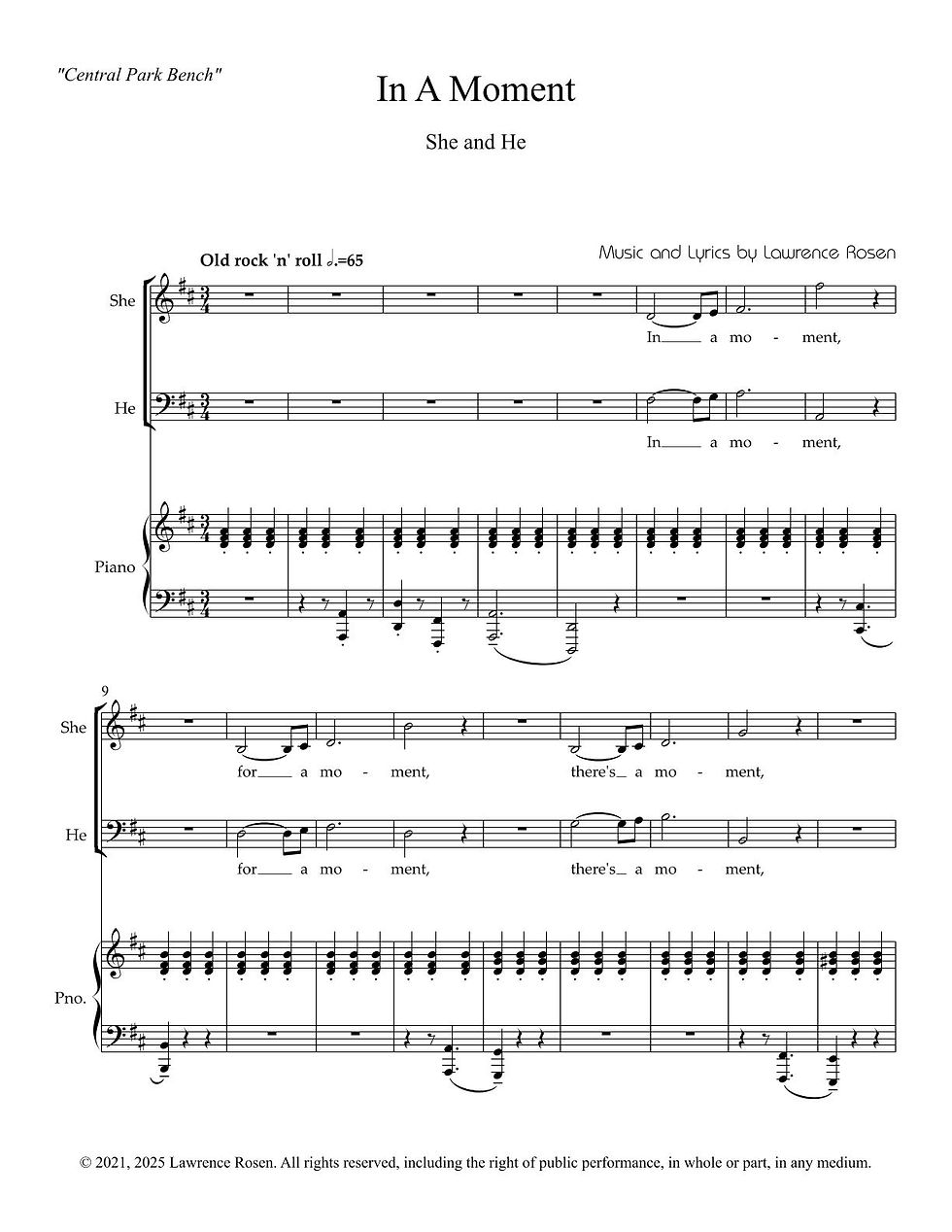
Central Park Bench takes place in the course of a single afternoon on an exquisite day in June, in a secluded, serene clearing near an area known as The Rambles in . . . yes, Central Park, New York City. One long, cement-base bench, with green wooden boards for seating and back rest. A beautiful, young middle-aged, fashionably dressed and exquisitely accoutered woman appears at the bench, somewhat nervous, apparently in expectation of meeting someone there. Soon, a New York homeless man visually, at least, a total bum (you can, I hope, forgive the traditional terminology) head to toe, with his own collection of accoutrements - a rusted shopping cart with a random collection of discarded items - sits at the opposite end of the bench about to eat his lunch, pulled from a decidedly second-hand brown bag. Who are these two? Why are they here? What happens?
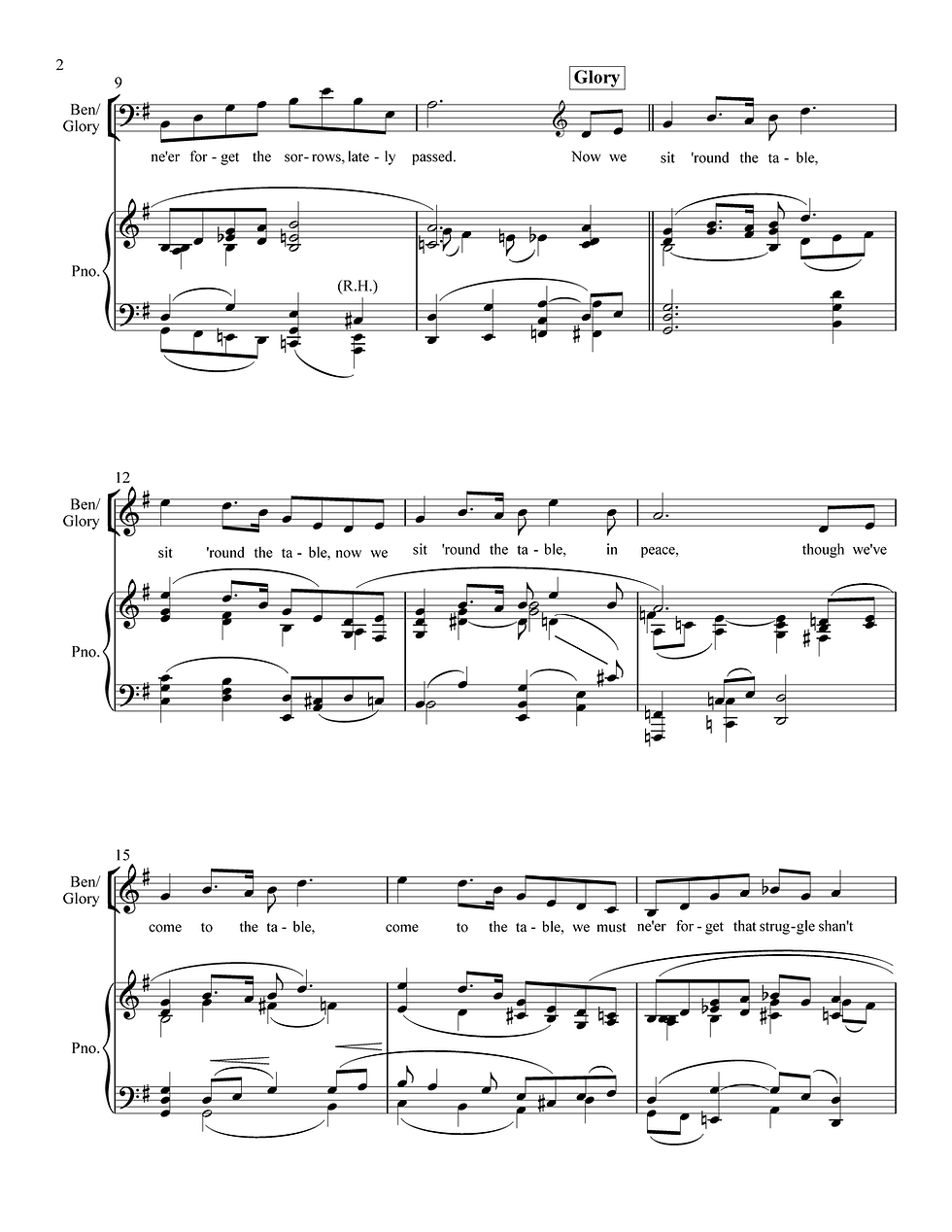
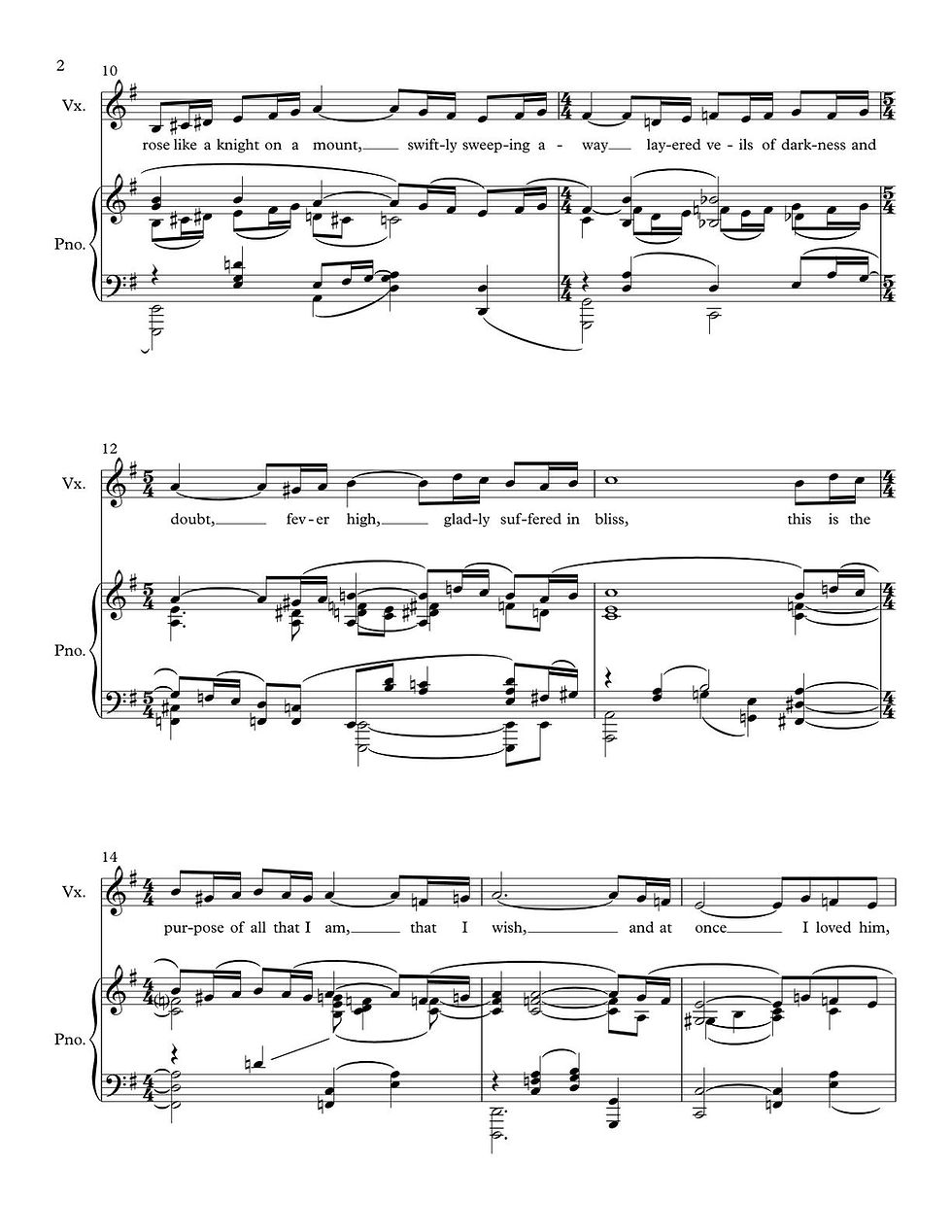
Central Park Bench is a “two-hander,” performed on a unit set with no costume changes, and with commonly available props. Its genesis was Covid-19: the necessity arose for a small, simple show, portable, cheap and easy to produce, but (hopefully) substantive enough to sustain audience interest. Offered here is the Piano-Vocal score only. All of the numbers are either male solos, female solos, or duets. The male role is an opportunity for a virtuoso character portrayal, and the female role is ideal for an actor/singer perhaps seeking to emerge from ingenue and soubrette roles. The integrated Book/Libretto is only available under a separate theatrical production agreement. Arrangements for theatrical presentation can be fairly simple and straightforward, and are always negotiable and flexible, depending upon location, venue, type and size of house, and the number of projected performances.
Meanwhile, we sincerely hope you enjoy the music from Central Park Bench.






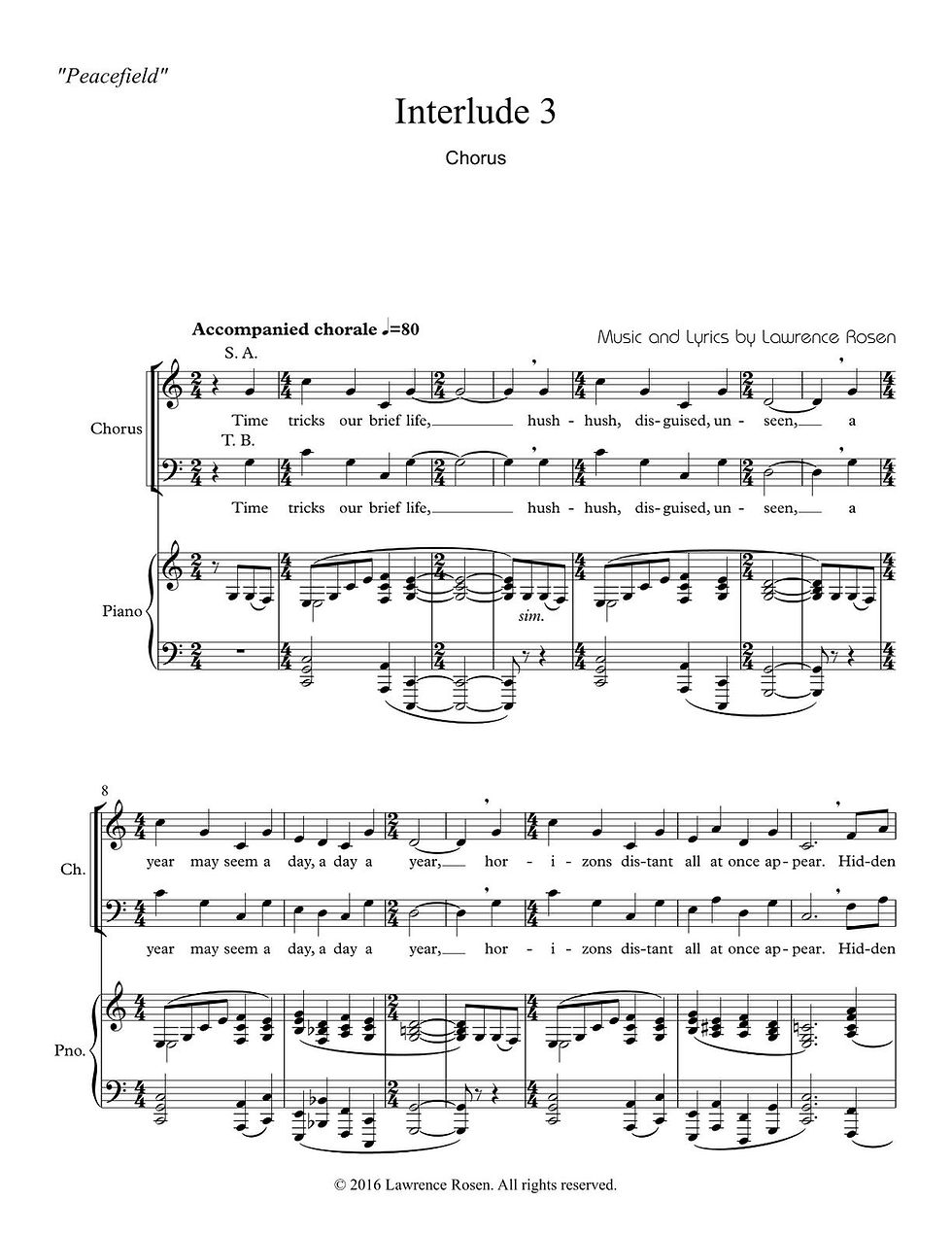
Peacefield
Episodes From An Early American Love Story
There are no monuments in Washington, DC, erected in his honor, though one has been planned for the better part of a century. No memorial plaques, at least any that anyone would go out of their way to see. No national holidays commemorating his life, ideas, creations, and essential contributions to the emergence of a new, experimental nation, though he is now lumped into the all-inclusive “Presidents Day.” He and his closest friend, fellow American Revolutionary, one time bitter rival, and intellectual comfort of his old age, both died on the same day, July 4, 1826, exactly fifty years to the day of the signing of The Declaration of Independence. He was married to a woman - effectively a founding “father” herself - who was considered by some of the finest known writers of the time, to be the best writer among them all. He was father to a man who spoke and read at least five languages (including Greek and Latin,) a scholar, university professor (Harvard and Brown,) congressman, secretary of state, senator, president of the United States, and a US diplomat while still a teenager - the first American to be received at the Imperial Russian Court, and a principal largely responsible for securing critical loans and guarantees from Dutch bankers. As a side activity, he helped create The Monroe Doctrine and contributed to the Treaty of Ghent, settling the War of 1812.
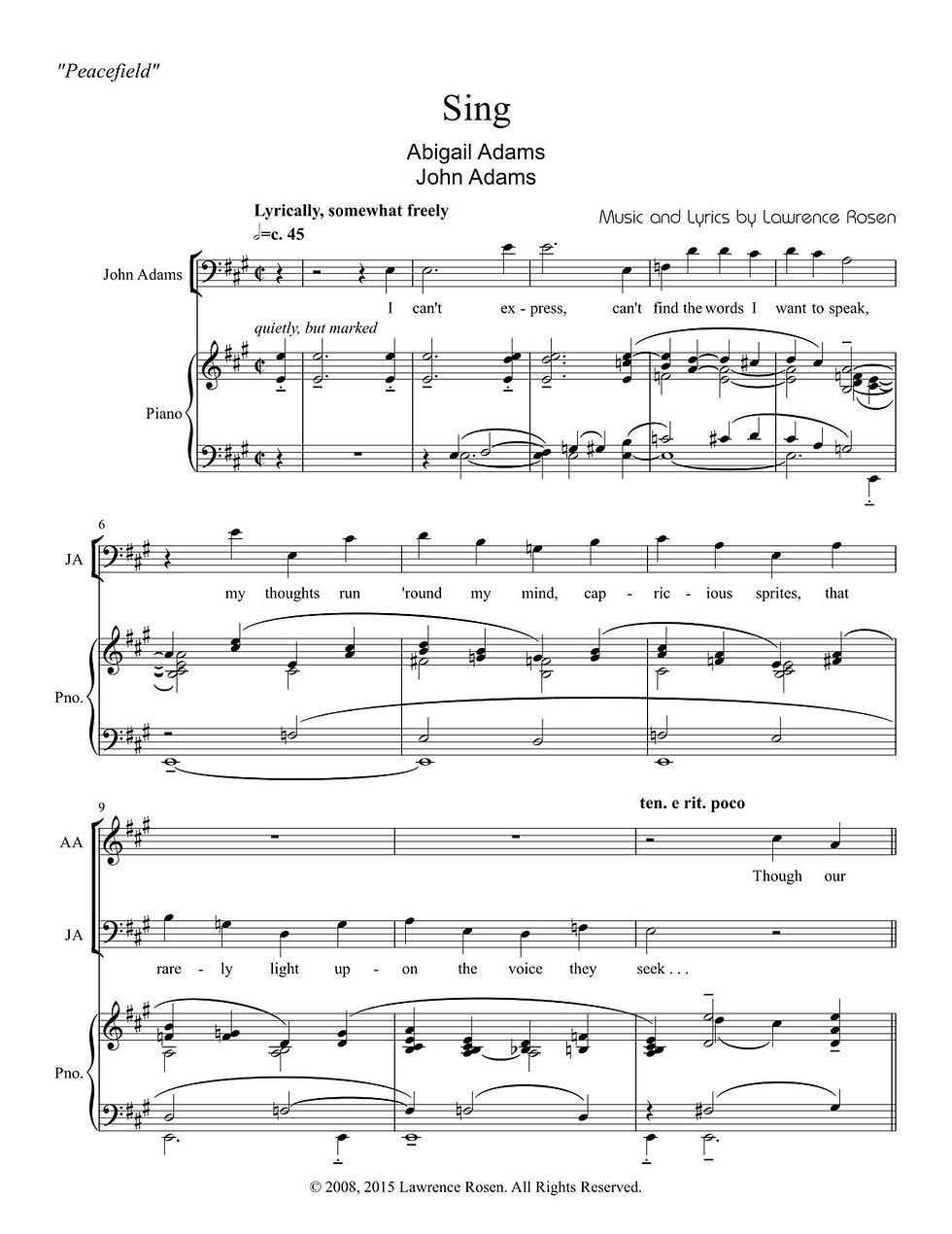
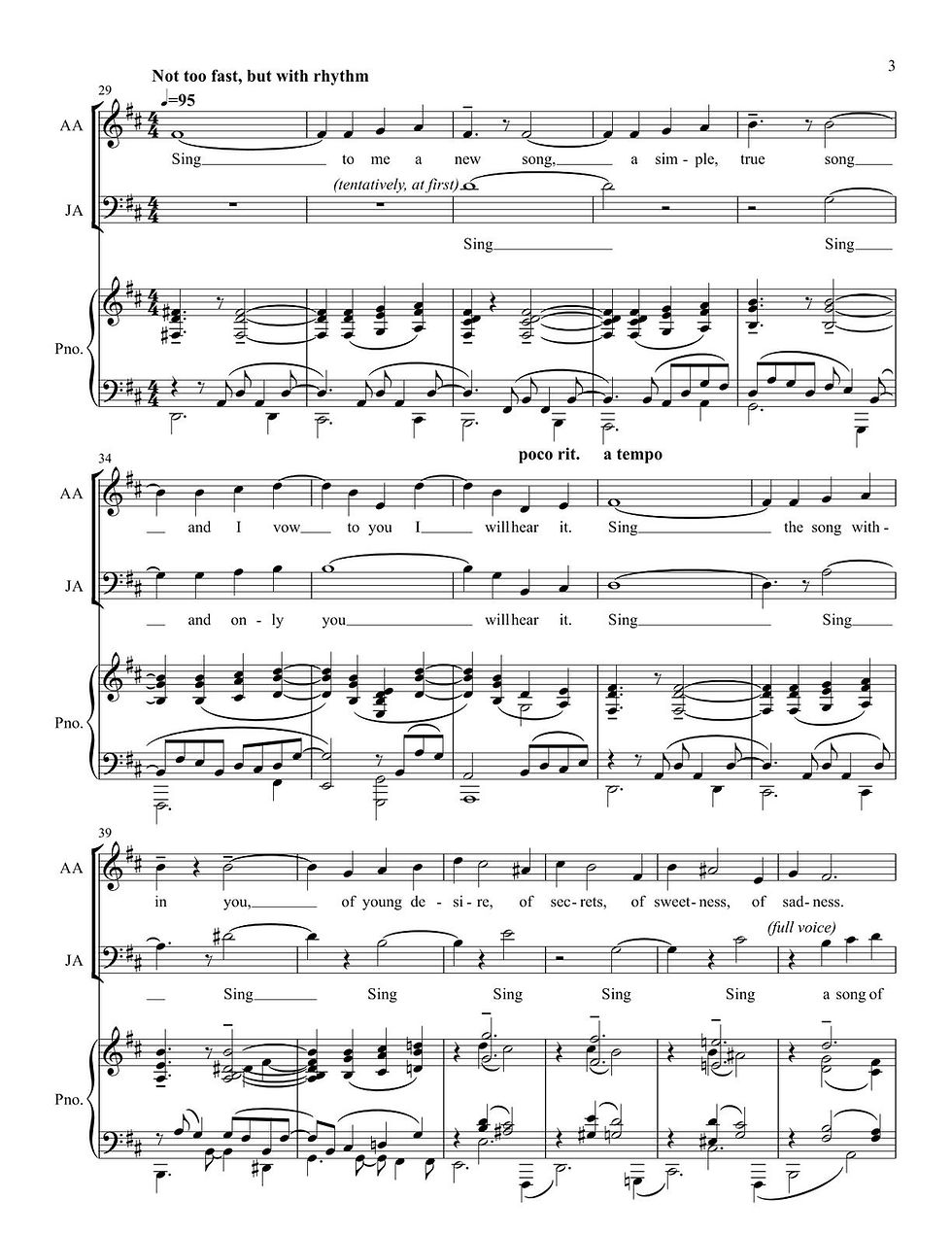
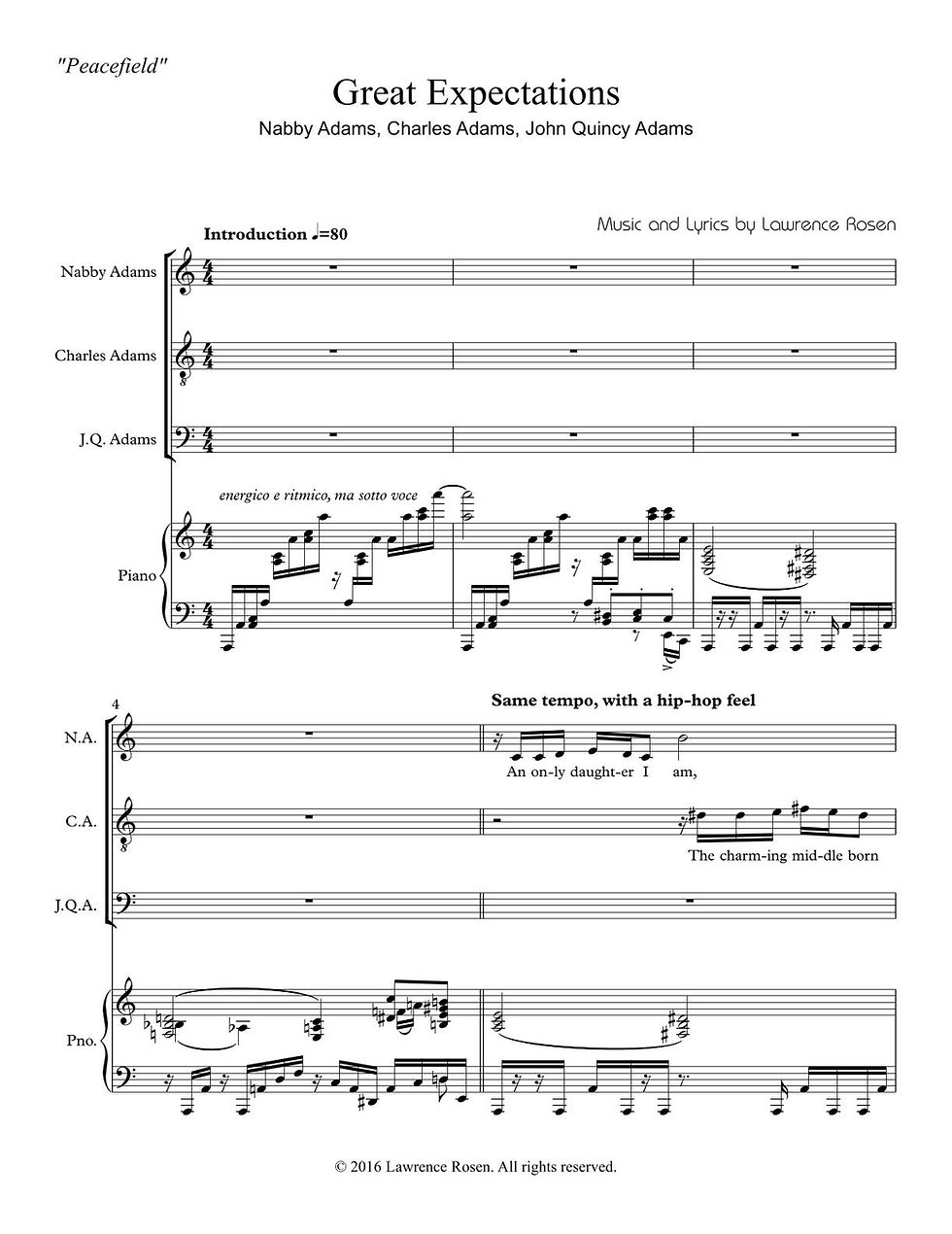
Peacefield, Episodes From An Early American Love Story, traces the courtship, marriage, family and careers of John and Abigail Adams, along the backdrop and formation of a new nation. They move through the earliest days of their courtship, the foundations of the Adams family, and become both accidental and committed participants in the architecture of the American revolutionary period and its complex aftermath. After Adams’s one-term presidency, retirement to the family farm, Peacefield, was welcomed and more than well-earned. The story of John and Abigail Adams is both an enduring personal story, and an essential one to the formative days of the United States.
Peacefield features John and Abigail Adams, their children, an Alexander Hamilton character, and a chorus which often serves in its ancient capacity as a commentator and interpreter. We offer here the complete Piano-Vocal score only, as part of the dramatorio format (see Thanksgiving At Molly’s above for a dramatorio explanation.) For those interested in full dramatic production, a Book/Libretto is available under separate agreement and contract.
It is my opinion that John and Abigail Adams, and their unique, vital participation in, and contribution to American history, government, and humanism, should be better known and celebrated than it generally is.








Eternal Stages
An American Musical Story
Some years ago, at a get together hosted by a celebrated conductor, Sheldon Harnick, the famous lyricist of the shows Fiorello!, She Loves Me, and of course, Fiddler On The Roof, held a circle of conversationalists mesmerized with some unforgettable, insider theatrical stories. He spun a saga of the early days of Fiddler On The Roof, on the road and out of town, where its survival was very far from secure. In Detroit, everyone was informed that if their Motor City run wasn’t successful, the show would be shut down and never make it to its New York opening . . . “closing out of town,” as the expression goes. They simply had to sell a certain quota of paid admissions. And everyone, including Harnick, the composer, the director, and the choreographer - were enlisted to go out and sell tickets . . . literally, hustle the show out on the street. Miraculously they were able to do so, the Detroit run was a smash, and they were then well on their way to New York and mega-hitdom.
At one of the performances, a patron came up to Mr. Harnick and said words to the effect of “. . . wow . . . really loved it. Great show! Of course, if I had known that it was going to be all about Jews, I probably wouldn’t have bought the tickets.”
I draw, or suggest, absolutely no comparisons between our show, Eternal Stages, and Mr. Harnick and his legendary production of Fiddler On The Roof. Except for one: the principal characters in both happen to be Jews.
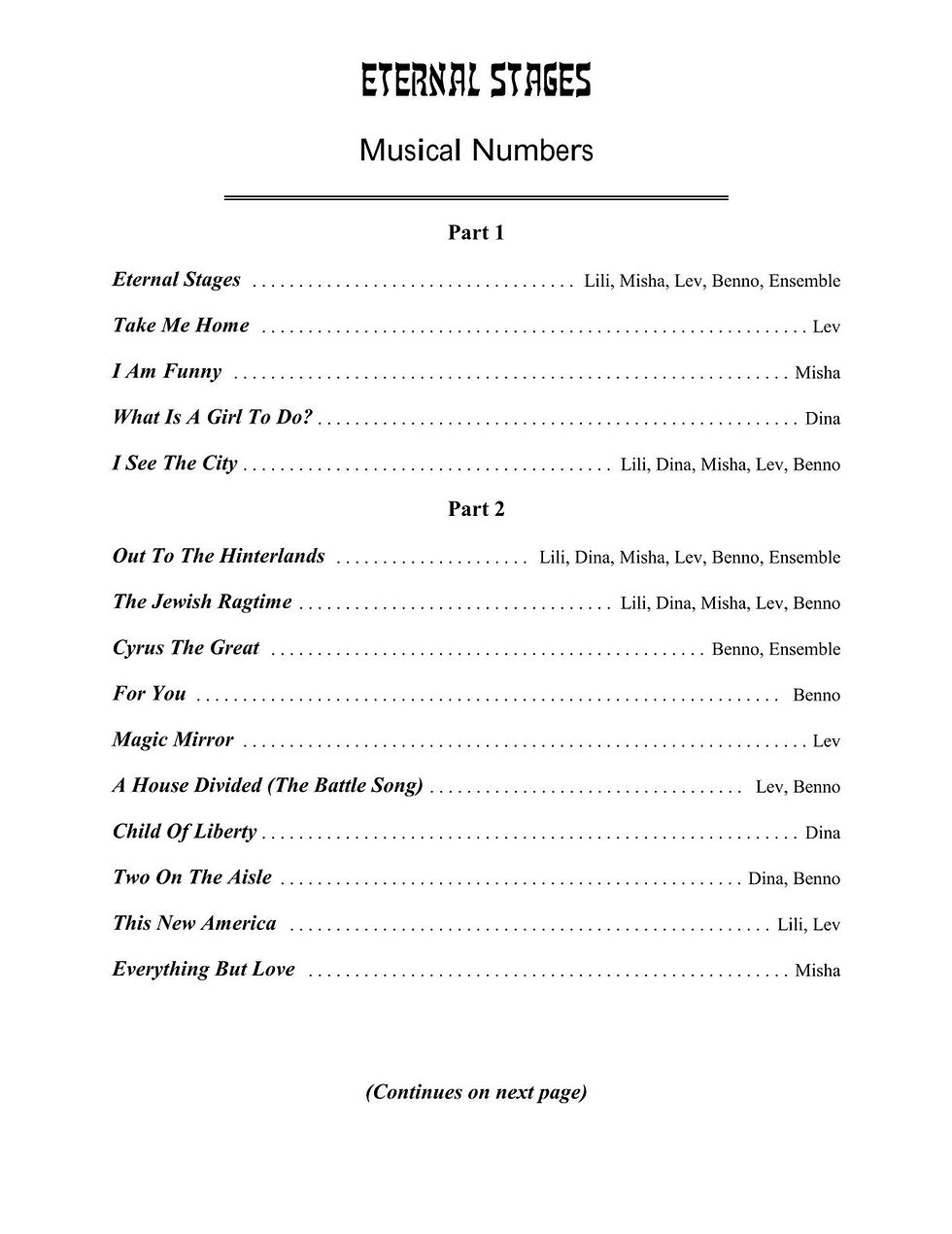
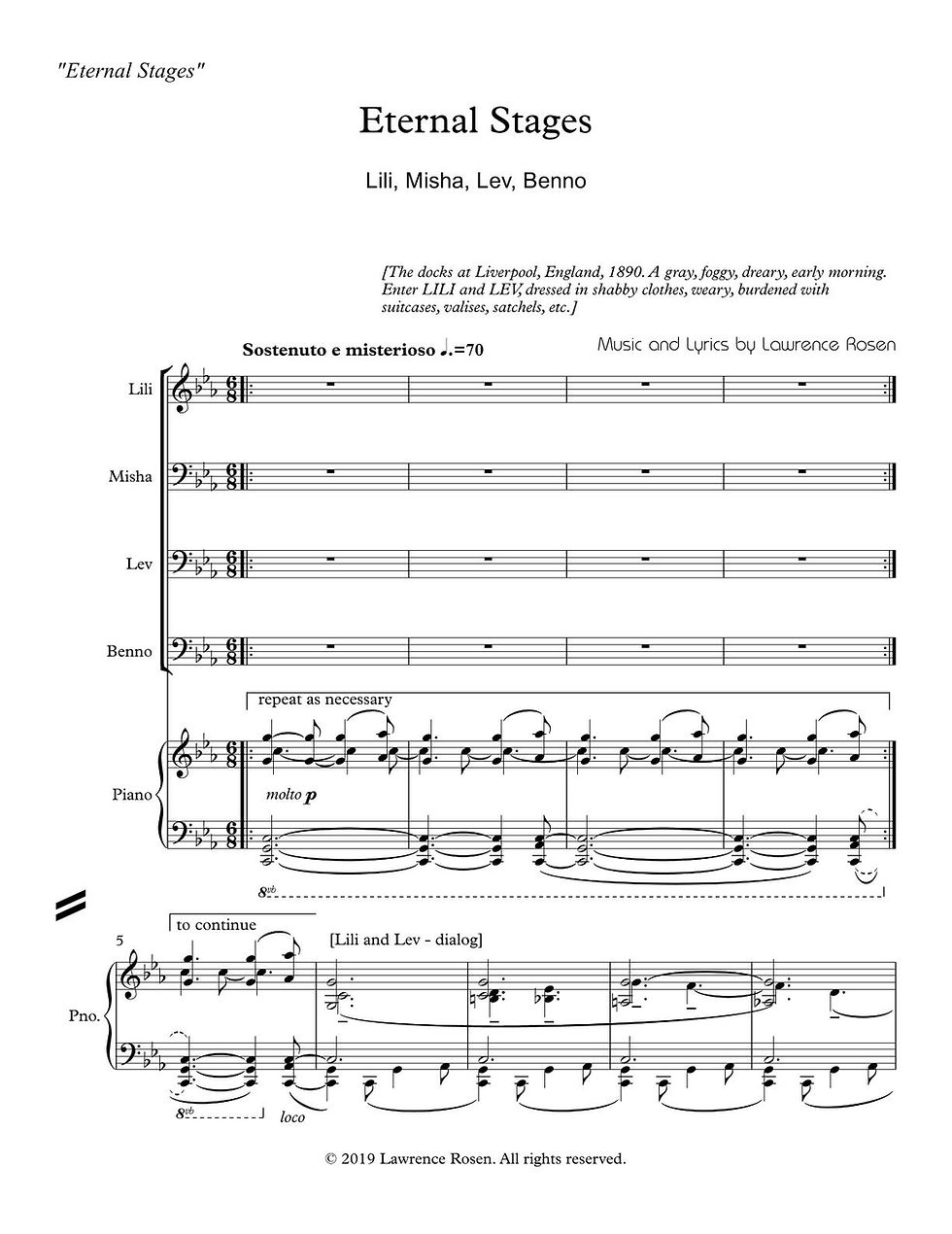
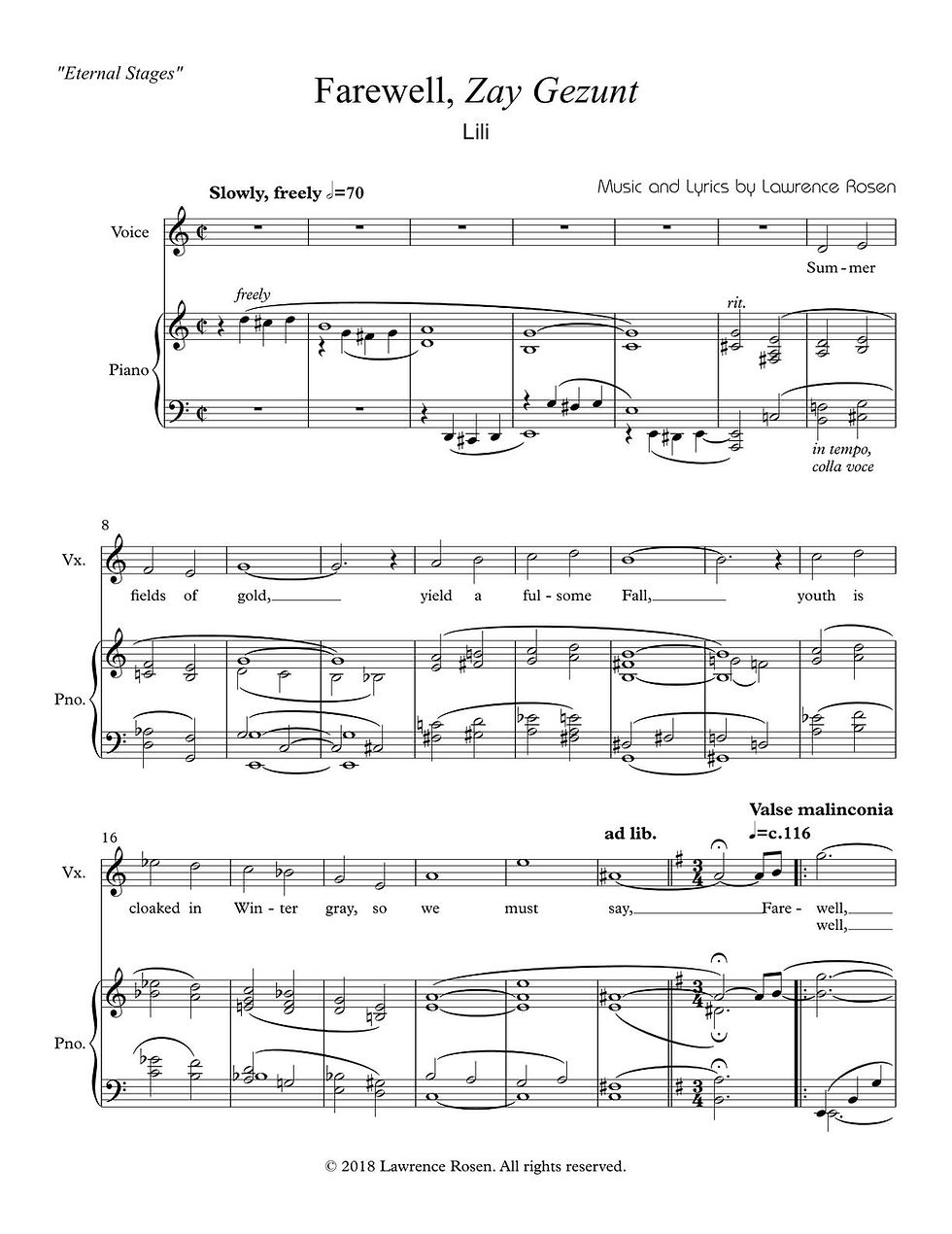
Eternal Stages traces the lives of five great Yiddish theater performers (composites modeled on actual individuals) from their departure for America in the late 19th Century, their eventual, immense success here, through the slow decline of the Yiddish Theater, and ending at the dawn of World War II. It is, at present, notwithstanding some valiant efforts to revive the Yiddish Theater and its language, a world vanished, unrecorded, and largely forgotten now. This is a story every bit about America and American immigration as it is about a particular immigrant identification, a story about an identifiable group who had untold, and continuing influence on the American stage, in movies, and eventually, even on television. It is a story about the blending and crossing of cultural and ethnic lines and the assimilation of these particular immigrant Jews into the American fabric and way of life. And, it is a love story to, and about the theater itself.
As with all our other theatrical stage works, a Book/Libretto is available for full production under a separate performance agreement (see elsewhere for elaboration.) We offer here the complete, piano-vocal score of the songs. A precise listing of the musical numbers is included, as is a Dramatis Personae.
Zei gezunt! Enjoy!






Lucky
A Musical Fable In One Act
After Aesop
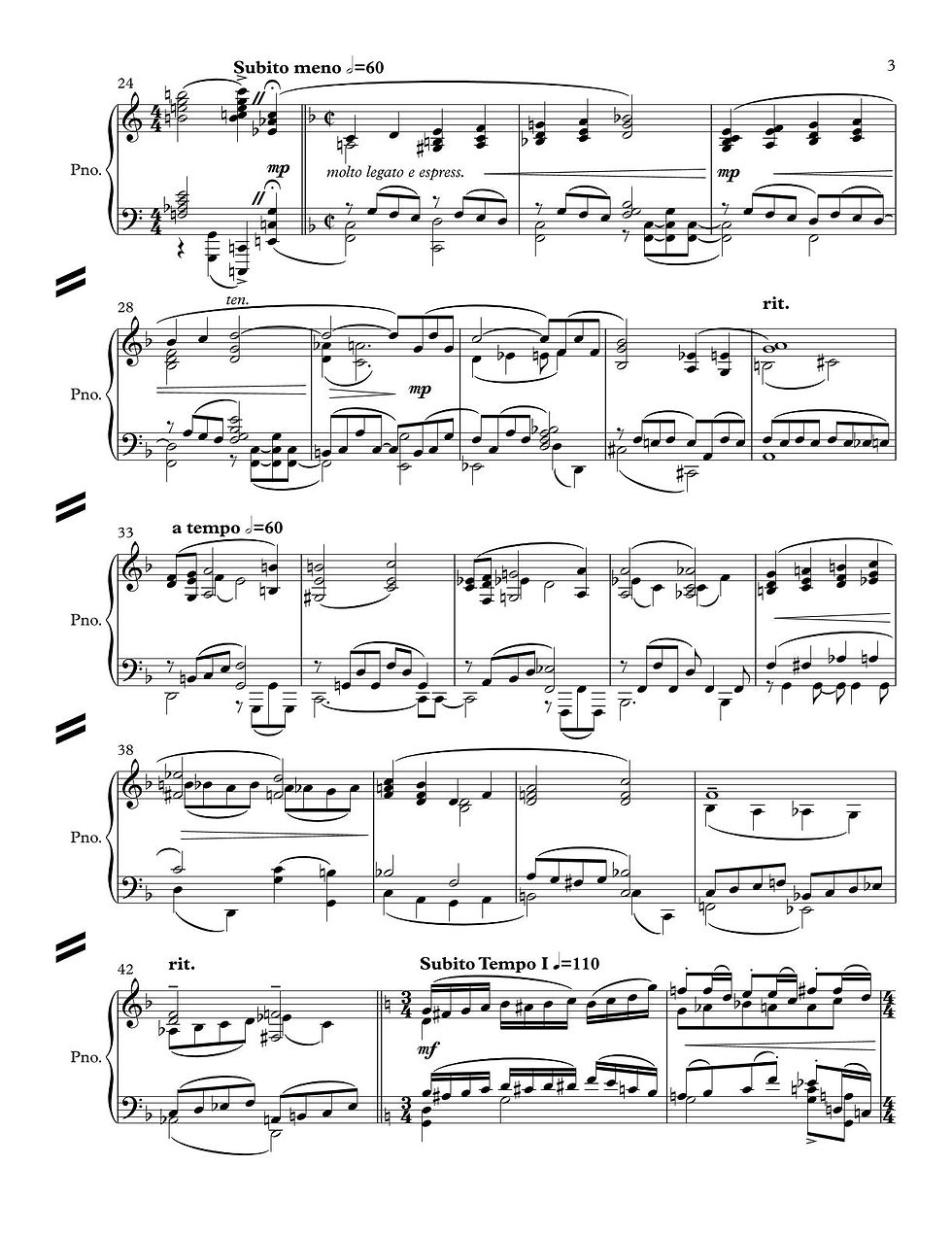
Lucky, a one-act prequel to Peter And The Wolf, A Stage Musical (see next item in our Theatrical Works category,) is meant to serve as the first act of a two-act, full evening in the theater . . . with Peter And The Wolf, A Stage Musical as the second act. The two shows/acts are absolutely intended to go together. And, they share an Entr’acte and an (optional) instrumental Intermezzo which further links Lucky and PATW together.
Lucky features almost the same cast (and each character’s associated character profile) as PATW, and the unit farmstead set is identical (though, between the two shows/acts, there could be a change of season.) Lucky is assumed to take place some time prior to the opening of PATW. At the end of the full evening’s experience, it is hoped that each act will illuminate the other. For a complete portrait of Lucky/Peter And The Wolf, A Stage Musical please cycle as necessary between this Lucky entry, the PATW entry and, under the Instrumental Works category, the Intermezzo. The score is episodic (as is Peter And The Wolf, A Stage Musical,) so there is no list of musical numbers proper, though we offer some musical example pages, following.








Peter And The Wolf, A Stage Musical
After the symphonic tale by Sergei Prokofiev
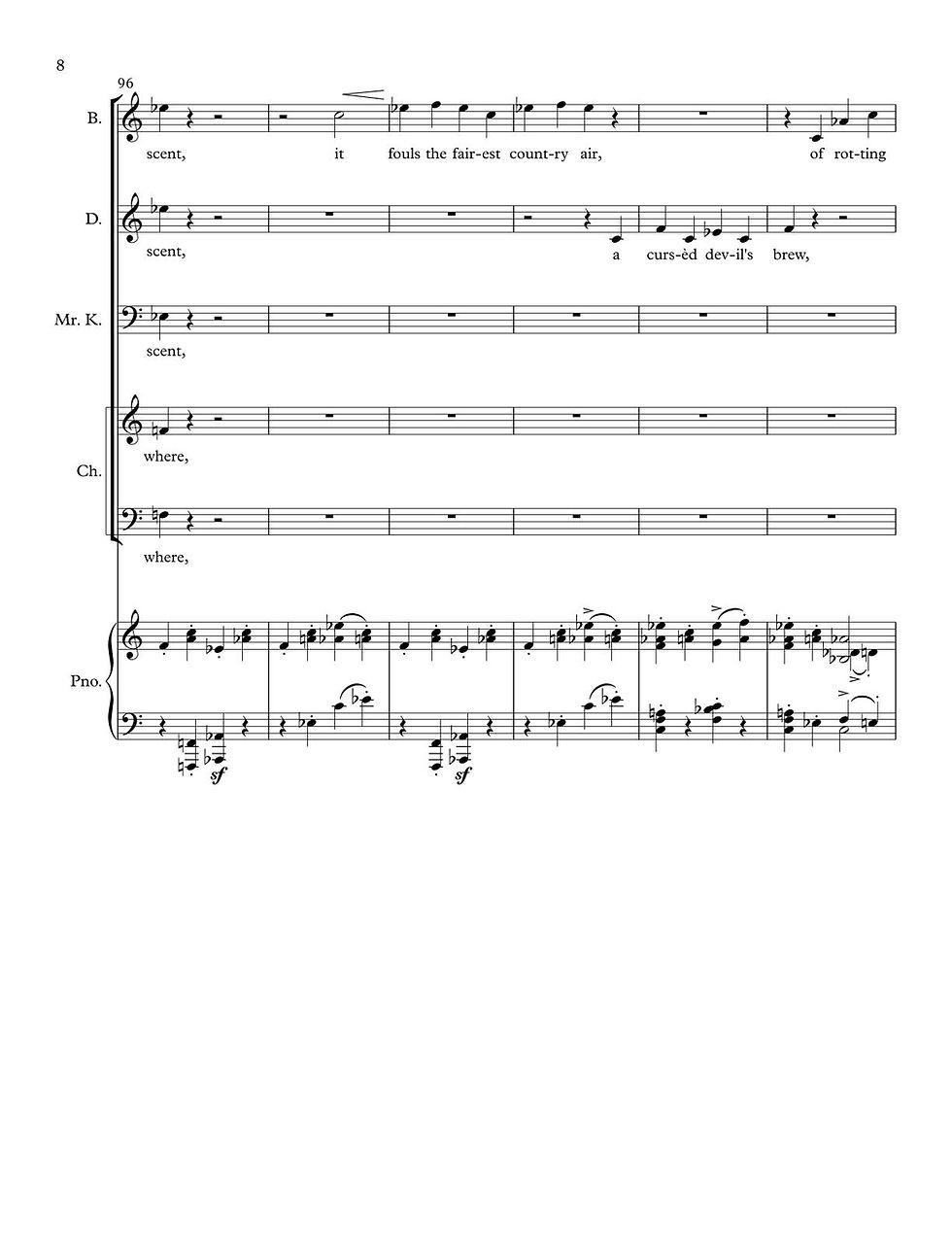
Peter And The Wolf, A Stage Musical, and Lucky, our original prequel to PATW, as well as the instrumental composition Intermezzo, (played after Lucky and before PATW) are the components that all go together for a full evening in the musical theater. At the risk of redundancy, not to mention the ever-embarrassing act of quoting oneself, I refer you to the text introductions to Lucky (above) and the Intermezzo (in the Instrumental Works category) for the full story of the genesis and composition of this evening (or matinee, of course,) in the theater.
Our PATW uses the original story line and cast of signature characters as the Prokofiev original of 1936, but dispenses with the narrator and adds a chorus of trees and shrubbery that, in addition to their vocal performance, move around the stage, and thus change the shape and composition of the unit set. There are no additions to the great Prokofiev’s original music, no interpolations or music alien to the original score, indeed, no musical violence of any kind, is added to or forced upon the music. We are, however, one hundred percent responsible for the dialog of the Book/Libretto, and of course, the Lyrics. The completely new prequel, Lucky, which features most of the same characters, the identical unit set (though with perhaps a change of seasons,) chorus, and costumes, is designed to both prepare as well as illuminate Peter And The Wolf, A Stage Musical, which follows it as a two-part second act.
I have no way of knowing, but Peter And The Wolf might be the most popular composition in all of “classical” music (arguably not including the Pachelbel Canon, Mendelssohn and Wagner’s Wedding Marches, and similar fare.) It achieves the almost impossible by combining rich, dramatic, often highly complex musical composition while simultaneously being eminently listenable, enjoyable, understandable, and totally unforgettable, even on the first hearing. It is adult music for children, and children’s music for adults personified, the poster child for substantive family entertainment. There is a version from back in the nineties with narration by Mikhail Gorbachev, Bill Clinton . . . and Sophia Loren. In what other context could this possibly take place?
Shortly after both pieces were completed, a major Broadway producer and his partners picked up Lucky and PATW, and in a shocking (to me, at least) whirlwind series of lightning events, we had a production contract. Thrilling. But then, Covid-19 hit and destroyed our prospects and the fast-forward progress we had been making - as so many other worthy people and projects of potential sadly, and even tragically, suffered at the time. We had some great stars on board to make a demo for the purpose of raising additional funds for the show, something I am not particularly crazy about (the demo, not the money.) I personally had even started original orchestrations for the evening (some completed.)
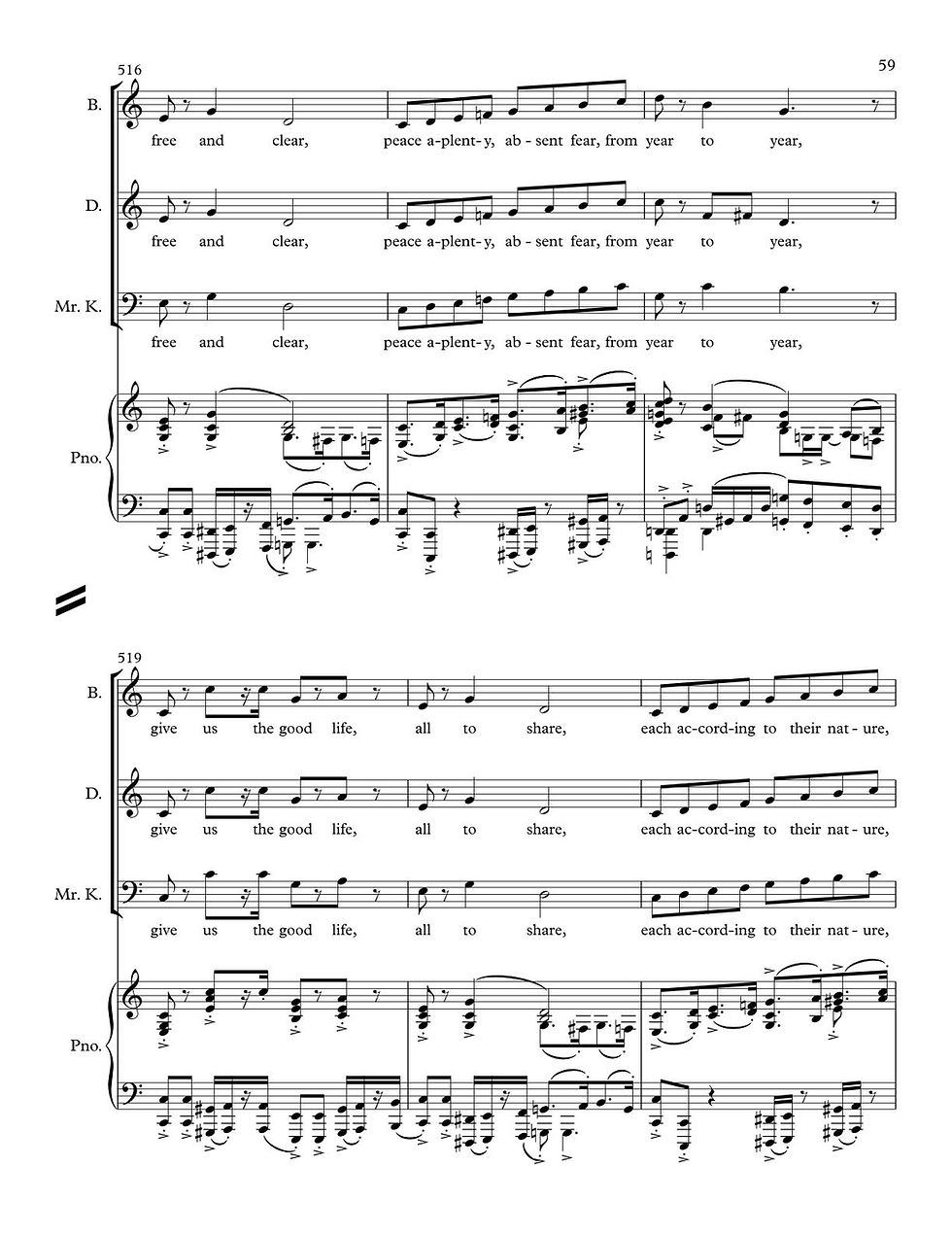
Here, for Peter And The Wolf, A Stage Musical, we are offering the Piano-Vocal score, and an incorporated Dramatis Personae. Since the music is essentially episodic, there is no traditional list of musical numbers. And following, is a selection of images from the Piano-Vocal score.




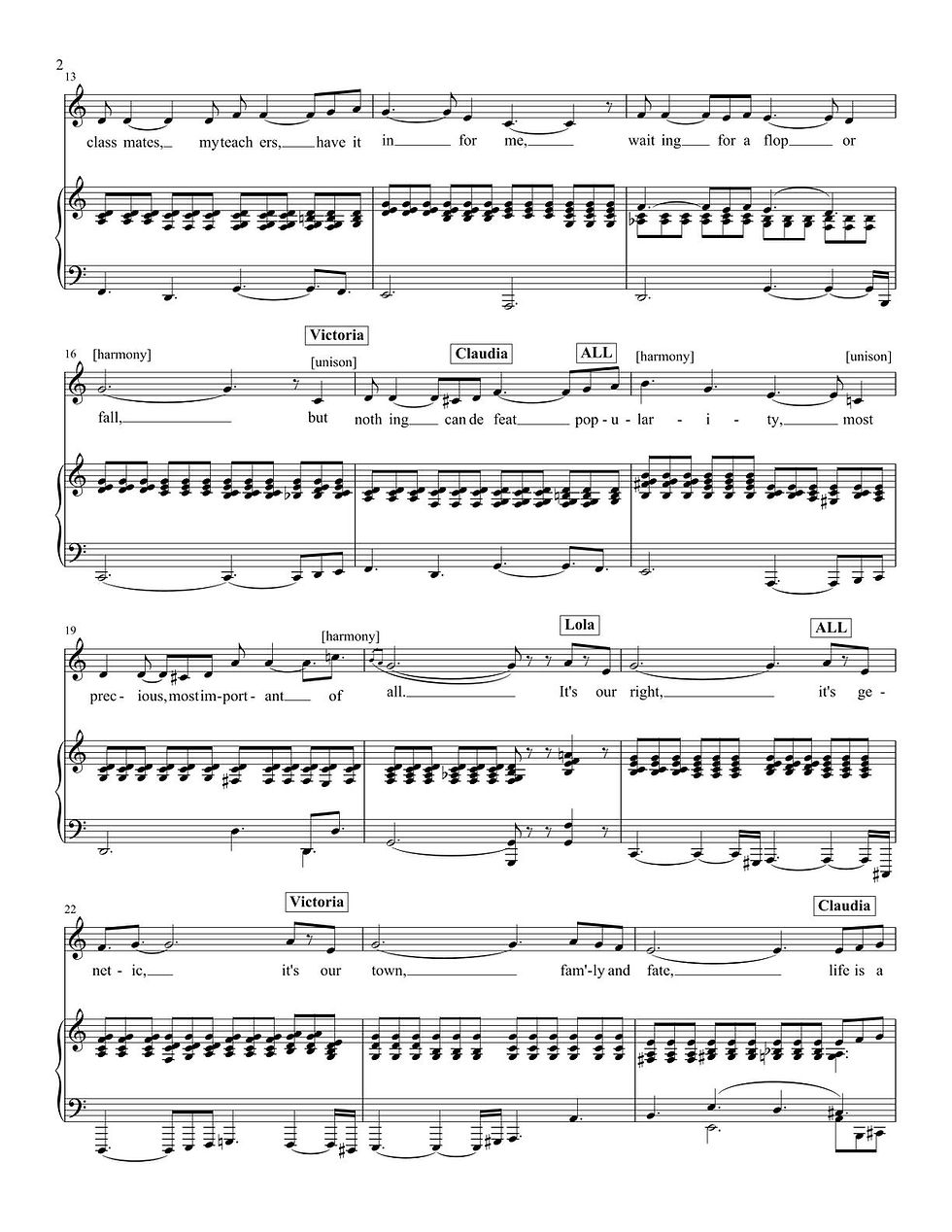
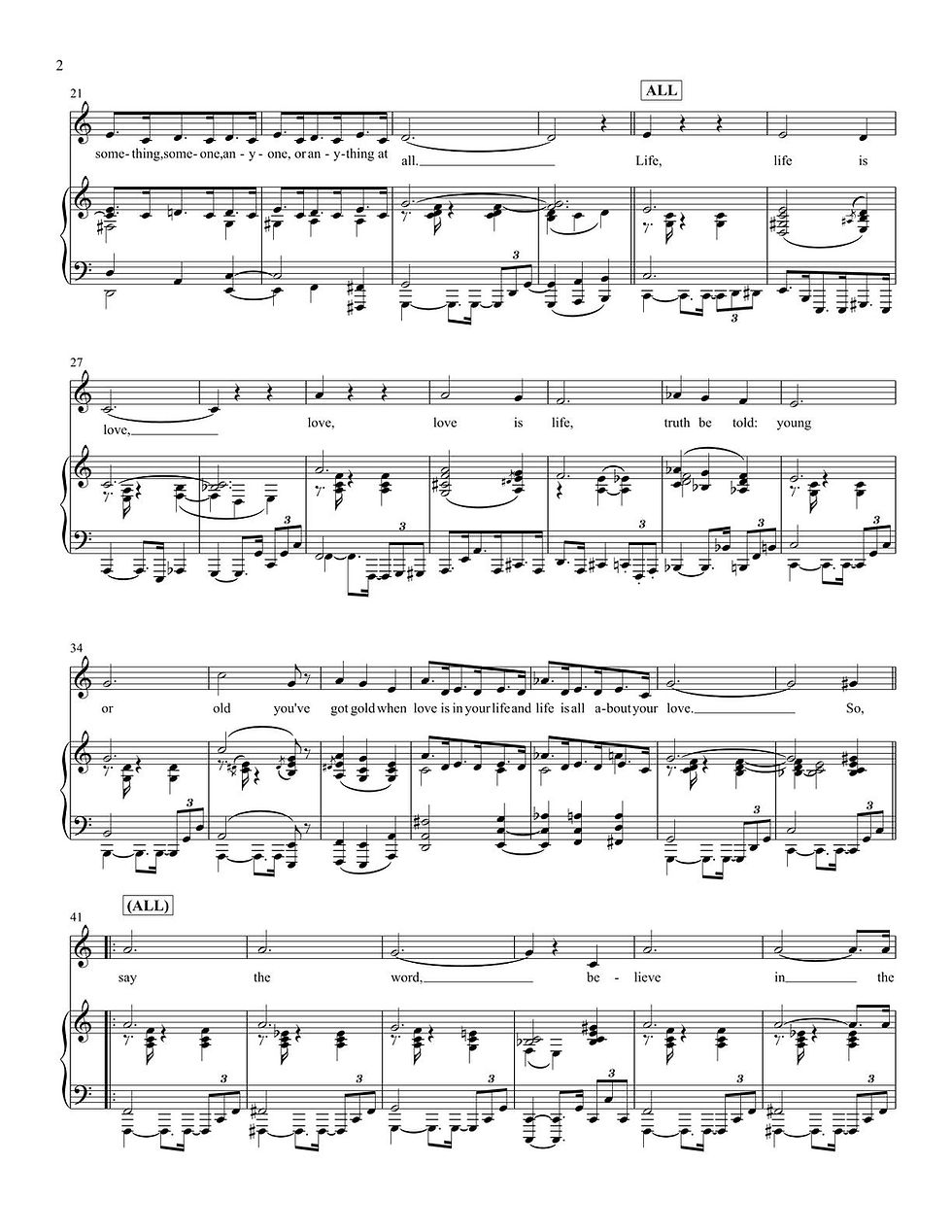
06880 : The Musical

When first approached to co-create a show about adolescent juveniles, I was quite hesitant. Not that I don’t like kids (I do,) but the period of adolescence is a time and a world which always has its own peculiar customs, music, clothes, language and slang, quirks, habits, and body chemistry, all of which change like the speed of lightning every few years. I was, thankfully, personally long past these troubling times that are so confusing, often dangerous, with its own collective of behaviors, and was not at all sure that I wanted to recall, let alone re-visit those years from my own life. But, when they put the contract before me, I signed it. The result was 06880 : The Musical, with a cast of nearly 20.
In two acts, we follow a group of somewhat privileged teenagers from ninth grade (Act One) to twelfth grade (Act Two) as they prepare to graduate high school. In our show, each character is played by two young performers, a ninth grade version, and a twelfth grade version. The show adds a school administrator, a wise, beloved teacher, and a mysterious character, Gabe Tempus, who occasionally takes the action of the show, via narration, out of time, sequence, and place. During the composition of the show, working directly with our young performers, it occurred to me that all non-teenagers, in one way or another, are just waiting for the teens in their life not to be teenagers anymore. Actually, when you think about it nobody really likes teenagers or wants to have much to do with them except other teenagers, and those - their families, educators, etc. - who have to, to whom both pity and great admiration are due.
While creating the show, it provided me an opportunity to get out of the city a few times a month into the tony, leafy, seaside community of Westport, CT (ZIP Code, 06880,) where it premiered and had its initial run at The Seabury Center. Subsequently, we played the Samuel Beckett Theatre (now Theatre Four) on Theater Row in New York City, crosstown at The York Theater with a single cast of twenty-somethings, and at a theater festival at Yale University. It was awarded the Moss Hart Award for Best Musical by the New England Theater Conference. But at that time Disney was gearing up with its own teenage theater productions, and as unstoppable as they always are, nobody seemed to have the stomach or the stones to go up against the Disney behemoth. And so, all of us pulled back to some degree on further production and dissemination for 06880 : The Musical. Inquiries for full theatrical production are welcome, as they are for our other theatrical stage works. Frankly, the book - which had an amount of contemporary topicality at the time of its premiere - could use a little sprucing up and updating but, we believe, the music and lyrics stand just fine as they are.
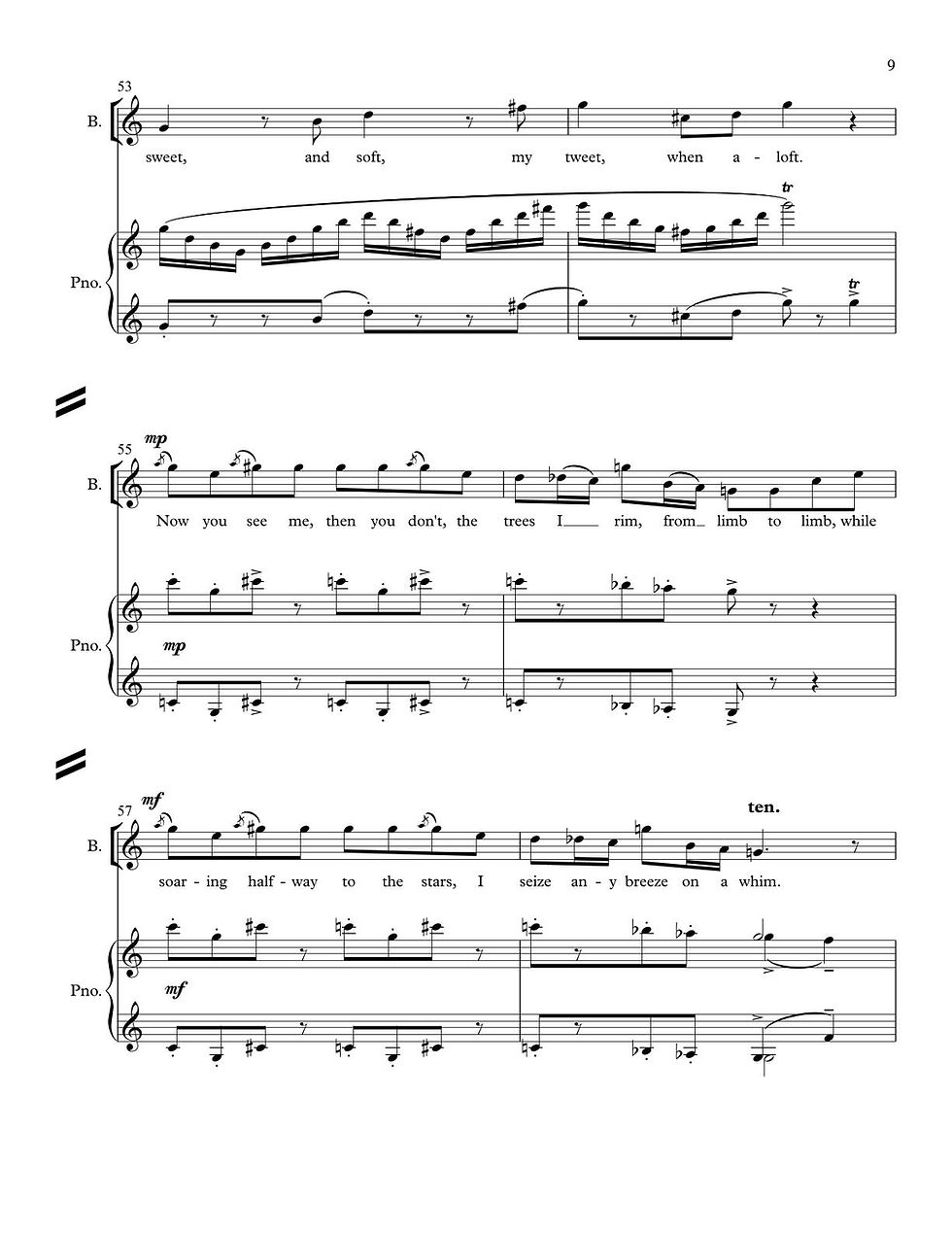
Here, as with our other theatrical works, we offer the complete Piano-Vocal Score. Following is a sampling of score page images and a few pieces of publicity material from the productions.




The Phantom Of The Opera
Book and Adaptation by Bruce Falstein
Music and Lyrics by Lawrence Rosen
Additional Music and Lyrics by Paul Schierhorn


By the late 1980s, everyone in the theater world knew that a sure-fire, Andrew Lloyd Webber juggernaut was about to invade Broadway, fresh off its mega-successful London opening at His Majesty’s Theatre. Even so, when The Phantom of the Opera opened at the Majestic Theater on W. 44th Street, few could have predicted that it would close only in 2023, after an unprecedented run of almost 14,000 performances.
Shortly after its New York opening, I went to see it, and enjoyed and admired it a great deal. The considerable critical and theatrical insider blowback it engendered (which apparently had zero influence on its success) was, in my view, then and now, for two main reasons. First, it was determinedly middle-brow entertainment, although of a highly sophisticated and skilled variety, both in the creation and execution of the work. And additionally, good old-fashioned jealousy and envy, appearing in so many varied, metaphorical manifestations, was prominently front and center . . . mostly aimed at the enormity of its success and the broad reach of its appeal.
Within a year or so of its New York opening, suddenly and without warning, my writing partners and I received an astonishing, totally absurd, possibly crackpot proposal: to create a new, original, American version of Phantom, directly drawn from the 1910 Gaston Le Roux novel, which had entered the public domain by the mid -‘80s.
It should be mentioned that as the Lloyd-Webber colossus was premiering in London and its Broadway clone was lurking in the wings, a number of American teams and entities had been working on their own Phantoms, some for quite awhile. To my knowledge, every one of these would-be, Phantom-pretenders, sadly and wisely, altered the theatrical trajectory of their own efforts so as not to be crushed, suicidally, by the incoming British behemoth. Some would eventually find a new life, and some would disappear forever.
For several days, we shared a lot of cynical humor over the proposal, but never did we consider taking these initial inquiries seriously. However, when an extremely attractive contract was put before us, with generous daily and travel expenses, luxury accommodations, a company that would eventually reach about 80 with complete front and back of house support, numerous miscellaneous perks, and a beautiful, old theater awaiting our “phantom” production, we signed on. Our joking suddenly turned into, “ . . . well, who wouldn’t want to spend December, January, and part of February in a lux hotel on Miami Beach?” But it wasn’t before long that we had to get real serious about the production, real fast.
It was the beginning of Autumn, and we had to write a complete show, from scratch, ready to go into rehearsal before Christmas, in Miami. From the Upper West Side of Manhattan, to the West (Greenwich) Village, to New Orleans, via computer and airplane, we three collaborators constantly shuttled back and forth for meetings and work sessions. Auditions were held around Thanksgiving at the New Yorker Hotel in Manhattan, and we were privileged to be able to assemble a stellar cast of principals: classical actor David Staller, with his powerful baritone and stentorian stage voice, as the Phantom, the prodigiously gifted, incredibly musical, and luminously beautiful Elizabeth Walsh as our Christine (both pictured above,) and the incomparably versatile Beth McVey as Carlotta. The company assembled in Miami Beach by mid-December for our residency, and included our director-choreographer, all of our designers, and our musical team of two orchestrators and five copyists. We opened, somehow, around February 1st to generally excellent reviews for a run in Miami of five months, before the show went on to play some other large venues around the country. Years later at a party in New York, Hal Prince, the director of the Lloyd-Webber Phantom on Broadway, told me that the legendary George Abbott, Mr. Prince’s mentor, then well over 100 and living in Miami, had gone to see the show and called him up enthusiastically to talk about it. Perhaps I felt a little too deferential at such news, but this embarrassed me terribly. Nonetheless, Mr. Prince was ever kind and even encouraged continued development of our show.
Mr. Falstein and I subsequently obtained the stock and amateur rights, formed a company called American Theatrical Publishing, and achieved about fifty-five productions before we quietly abandoned the effort.
Late in the Miami run, for some wholly nonsensical reason, the producers decided to create a “movie” of the show by shooting and editing together a few performances of the live stage show. Apparently, they had made a deal with the PBS outlets in Atlanta and Miami to air it. At the risk of shooting myself in the foot, I must be straightforward and honest . . . then and now I felt the result was quite atrocious. Visually, it looked like your grandmother and her eccentric best friend grabbed a couple of Sony Handycams and just started shooting, as if one of their grandsons was having a birthday party. The audio was approximately 50% non-existent, as if microphones were placed a block or so away and someone forgot to hire a sound engineer. The “movie” eventually aired on Miami PBS, airing in rotation for several weeks, and in some miraculous way, escaped the savagery of the critics and, quite to the contrary, was well received.
Adding another piece of misfortune to the story of this sorry cinematic endeavor, the producers decided that it should open in New York. When I learned of this, I immediately considered moving to, say, Nebraska and maybe selling insurance for a living. It opened at the 57th Street Playhouse (now the Directors Guild Theater,) and I decided to hide out at my home in New Jersey, before taking off for Nebraska.
A day after the opening on 57th Street, I got a telephone call from my mother, now of blessèd memory. She told me to go out and snap up all copies of the New York Times that I could get my hands on. I asked her why so, and she told me that the Times critic had given our “movie” a quite favorable review. To this day I could never understand why, but soon I started to receive calls about the review and remarks like, “ . . . gee, I didn’t know you were a movie composer!” Perception, it is frequently said, over reality, (sometimes) rules the day.
Coming to the present, I am still highly prejudiced against the movie, but remain quite proud and positive about the stage show we created under the most unusual, if not downright bizarre, of circumstances. If nothing else, creating and producing the stage version, as well as suffering the “movie” version, taught me more about public life in the theater than I could have ever learned in a classroom, seminar, or simply holed up in my studio.
At this writing, we can only offer a copy of the conductor’s score from the premiere production, at a bargain price, for perusal and examination. For those who don’t know what a conductor’s score is: created by our arrangers, orchestrators, and copyists, it’s a skeleton score, a reduction, a series of sometimes bare-bones cues drawn from the original orchestrations (we have orchestrations for an orchestra of 12,) so as to enable the music director to rehearse and conduct the production without the burdensome complexity of a full score - a very common practice in the musical theater. We are in the process of creating the full piano-vocal score, and will announce its availability on this site when ready. Production inquiries for the full stage show are always welcome and, as mentioned several times elsewhere on this site, are only available under a separate production contract.
And, we must thank you for your indulgence in this overly long introduction. For those of you who acquire the conductor’s score, we think it can render a very decent idea of the musical content of the show, as well as an insight into the working materials of Broadway shows in general.


